Five Find-Outers

The Mystery of the Disappearing Cat by Enid Blyton, 1944, 1966.
Bets is happy that her brother, Pip, is coming home from boarding school, and he’s bringing his friends to visit. Now that the children are reunited, Bets and the others hope that they will find another mystery to solve! The others ask Bets if anything interesting has happened since they were home last, and she says not very much, although someone has moved into the empty house next door. The new neighbor is Lady Candling, who keeps Siamese cats.

The boy who helps the gardener, Luke, is nice and allows the children to visit and see the cats. Lady Candling says that the Siamese cats are valuable prize-winning cats. She keeps them in a large cage most of the time for safety, but Miss Harmer, the housekeeper, takes one out to show the children. Unfortunately, one boy, Fatty, owns a Scottie dog named Buster, and Buster comes into the garden looking for him. Buster frightens the cat and chases her! The cat claws Buster after he chases her into the bushes, and they manage to get Buster under control, but they have trouble finding the cat. Miss Harmer is upset that her cat is lost, and Bets goes to search for the cat.

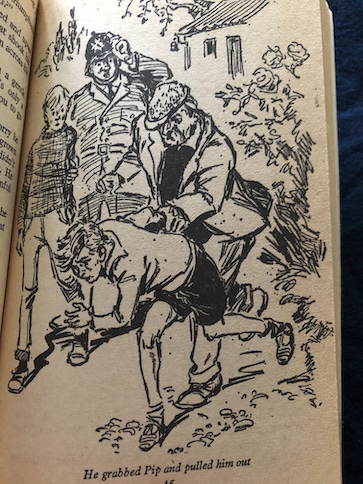
While Bets is looking for the cat, the gardener, Mr. Tupping comes to find out what the fuss is about. Mr. Tupping is a violent and short-tempered man. (They also emphasize that he has a hooked nose, which I think is probably a stereotype. Enid Blyton’s books often contain derogatory racial stereotypes, although later printings have been revised to remove them.) Mr. Tupping hates children and animals, and he grabs Buster and locks him up, threatening to beat him later. The children try to help Buster, but he chases them out of the garden. Bets is left behind, but she locates the missing cat, and Luke helps to free Buster and get Bets out of the garden without Mr. Tupping seeing her. However, Mr. Tupping threatens Luke with dire consequences if he ever lets the children into the garden again.
This is just the beginning of their troubles with Mr. Tupping. When Mr. Tupping finds out that Bets has visited Luke again, he storms into Bets’s own little garden, rips her strawberry plants out of the ground, burns them, and yells at her. Bets is afraid to report him to the adults because she’s afraid that Luke will get in more trouble with Mr. Tupping. Luke is a poor orphan who lives with his stepfather, and he desperately needs the job, which is the only reason why he continues to work with the nasty Mr. Tupping. Mr. Tupping is also friends with the local policeman, and the children know that the local policeman resents them for solving a mystery before he did, so they’re sure that he will side with Mr. Tupping, no matter what they say about him.

Then, Lady Candling’s prize cat, Dark Queen, disappears, and Luke is blamed for stealing her! The children are sure that Luke is being framed for the cat-napping, but the evidence is against him. Pip and Bets’s own mother saw the cat in its cage when she went to tea with Lady Candling, and Luke was working in a garden bed nearby. Even Luke says that no one else went near the cage between then and the time when the cat disappeared. When a wooden whistle Luke made is found in the cats’ cage, the children are sure that it was planted to frame Luke, but how can they prove it? Then, the cat reappears, and later disappears again! What is going on?
The book is available to borrow and read for free online through Internet Archive (multiple copies).
My Reaction and Spoilers
I found this story frustrating because all of the adults in the story are so oblivious to Mr. Tupping’s violence and aggression. He is actively abusive to the children and animals, but nobody seems to notice or even inquire about signs of trouble. Bets’s mother never seems to notice that all of her daughter’s strawberry plants have suddenly disappeared from her garden and never asks her daughter what happened. Mr. Tupping is able to just march onto the family’s property and abuse an 8-year-old girl with complete impunity, and her mother never notices a thing. (Of course, if I were the girl in question, I would have done what I used to do when I was picked on as a kid – take a deep breath, throw back my head, and scream continuously until help arrives. I figured out at a young age that if you scream from your diaphragm, you can get extra volume and keep the scream going for longer without straining your throat, and it’s difficult for the adults to ignore. You can’t scream like that at every inconvenience or people will start to ignore it, but it’s definitely an attention-getter if you use it when it really counts! Just let Mr. Tupping explain his presence and actions when the adults come to find out why their daughter is screaming like she’s being murdered!)
Mr. Tupping is a very obvious villain. He’s also the first person on the scene each time the cat disappears, the one who strategically assigns Luke to work near the cats’ cages just before the prize cat disappears each time, and the keeper of the key to the cats’ cages when Miss Harmer is away, which she is each time the prize cat disappears. Yet, even though he has means (the key), motive (he hates the kids and animals and wants to get rid of Luke), and opportunity (always the first person in the cats’ cages whenever the cat disappears and the one person who controls where Luke is working), all of the adults immediately look at Luke as the thief, never even questioning Mr. Tupping. An adult would be more likely than a kid to know where to sell a prize-winning cat (heck, as a an adult, I wouldn’t even know where to deal in black market animals), but nope, all of the adults first think a kid did it, like kids have those kinds of criminal connections to the prize cat black market. It drove me completely crazy!
It’s worse because Mr. Tupping is friends with the local policeman and gets favoritism because of it. When the kids consult their friend who is a police inspector, he finds out that Mr. Tupping has a police record for being involved in a dog-napping case (surprise, surprise), which establishes his criminal history and connections to people who deal in stolen animals. I was disgusted that the local policeman never looked into his background himself, but I felt a little better when the inspector reprimands him for making friends with a criminal and overlooking evidence that implicated him and trying to prevent the children from bringing evidence and concerns to light. The local policeman is embarrassed, but at that point, I felt like he deserved to be.
The villain was obvious, but what saved this mystery was that he actually used a clever trick to confuse the time when he actually took the cat. I knew from the beginning who the cat thief was, so the real mystery for me was how he got the cat out of its cage without people seeing him. It turns out that Mr. Tupping takes the cat earlier in the day than everyone thought the cat was stolen. The Siamese cats look very much alike, but the one that was stolen had a marking that was different from the others. With a bit of paint, Mr. Tupping makes a different cat look like the missing one for most of the afternoon, quickly using a bit of turpentine to remove the paint at a strategic moment to make it seem like the cat disappeared at a time when Luke was near the cats’ cages.
 Jestress's Forgotten Books and Stories