Bobbsey Twins
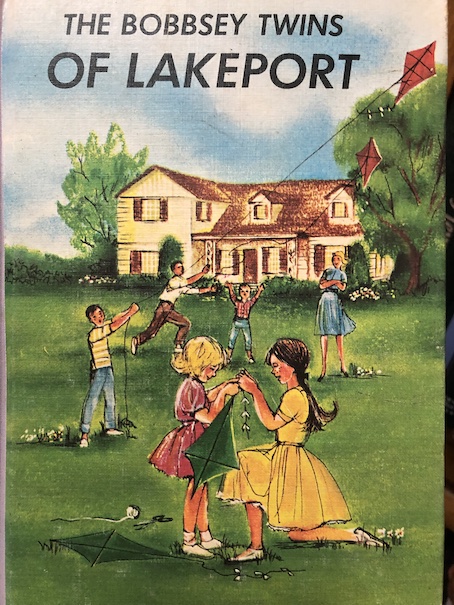
The Bobbsey Twins of Lakeport by Laura Lee Hope (Stratemeyer Syndicate), 1904, 1961.
Before I begin discussing the story, I need to explain that this story, I need to explain that, in the 1950s and 1960s, children’s series books from the Stratemeyer Syndicate that were still in print were rewritten and reprinted to update slang and cultural references and, importantly, to remove inappropriate racial language and stereotypes. This was the time of the Civil Rights Movement, and people were becoming more self-conscious about the language they were using and what they were teaching to children. The Bobbsey Twins was one of the series that was rewritten, and I was surprised by some of the things that appeared in the original printings of the first Bobbsey Twins series. As a kid, I was more familiar with The New Bobbsey Twins series, which was written in the 1980s and 1990s. The Bobbsey Twins was one of those series that has multiple sub-series, sort of like the various incarnations of Scooby-Doo cartoons, each one updated to fit the decades when they were written. The original Bobbsey Twins series was first written in the early 1900s, and the way it originally portrayed the black couple who work for the Bobbsey family was very problematic. I was really surprised. The edition that I’m describing below is the revised 1960s edition, with the problematic elements changed or removed.
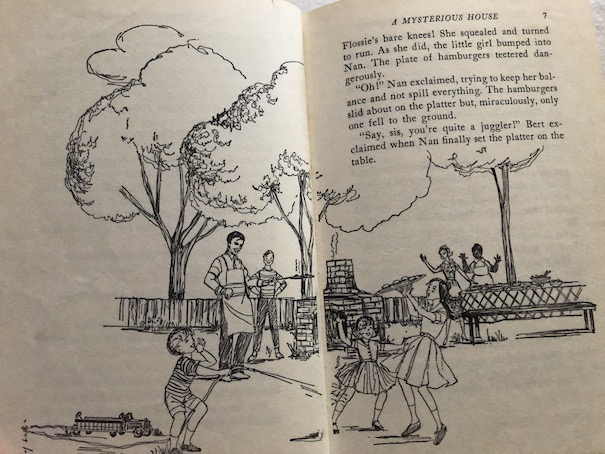
The story begins with both sets of Bobbsey Twins – the older set, Nan and Bert, and the younger set, Freddie and Flossie – disassembling their old tree house because they’re planning to build a new one. Six-year-old Flossie mentions that a spooky old house near their school is also going to be torn down, and Freddie says that another kid at school claims that house is haunted. The children’s father says that they must be talking about the old Marden house. It used to a farmhouse, but the town has grown around it. Mr. Marden was a wealthy man who had once been ambassador to Great Britain, and he build the large house when he retired. Since then, the place has become disused and badly run-down, which is why the kids think it’s spooky and why it’s going to be torn down.
The children’s mother explains that she knows Mrs. Marden, who is the widow of the original Mr. Marden’s grandson. Mrs. Marden is now elderly, and she sold the old Marden house to the school when she went to live in a nursing home. Mrs. Bobbsey says that she hasn’t been to visit Mrs. Marden lately, she decides to pay her a visit that afternoon. The kids are still curious about whether the house could be haunted, and they ask their mother to ask Mrs. Marden about it. It doesn’t seem likely that the house is really haunted, even though it is old and spooky-looking. Danny, the kid at school who claims that he’s seen ghosts around the place, is known for playing mean tricks, so he’s not a reliable witness.
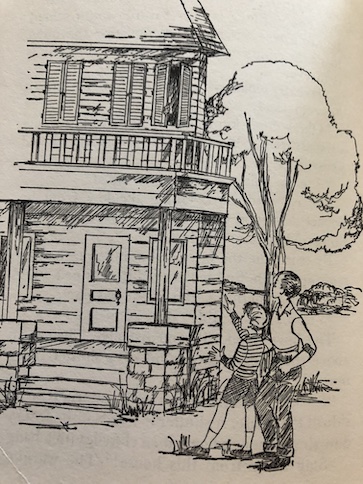
Bert suggests to the others that they could go take a look at the house themselves. When they get there, they see men surveying the property. The men say that, after the house is torn down, it will be replaced by an addition to the school. The kids ask the men if they’re worried about the house being haunted. One of the men says that he heard some strange sounds, but he thinks it was just a couple of local boys playing a prank. The men don’t think that there’s a real haunting there. The Bobbsey Twins want to see the inside of the house, but the surveyors tell them that they can’t go inside because the house is locked up to discourage vandals. The kids spend a little more time with the surveyors, helping to hold their equipment and seeing how it works. However, the children are still curious about the house and wish they could investigate it more.
Then, when their mother comes home from visiting Mrs. Marden, she tells them that there really is a mystery about that house. Mrs. Marden’s memory is failing her, but she knows that some valuable souvenirs from old Mr. Marden’s time as an ambassador are missing. One of them is a cameo surrounded by diamonds (the book defines what a cameo is for the benefit of kids who don’t know) and a collection of obsidional coins. (The book also explains what these coins are. The characters had to consult a book because even Mrs. Bobbsey doesn’t know. I hadn’t heard of them before, either, because I don’t know much about coin collecting. They’re basically improvised coins made during times of siege to pay off soldiers. They’re made from whatever materials the makers had at hand and are often irregular in shape. I love stories that explain interesting and unusual historical details!) Mrs. Marden knows that she hid these things somewhere in the old Marden house, but she just can’t remember where. Since the house is going to be torn down, there isn’t much time left to find them!

Mrs. Bobbsey gives the children permission to investigate and tells them that the principal at their school has the keys to the house. She thinks that the principal might let the kids into the house if they explain that they want to retrieve something for Mrs. Marden. The school principal is surprisingly agreeable to the idea of the children poking around the old house and gives them the key, but Danny overhears their conversation and tries to convince them again that the house is haunted.
When the twins and a couple of their friends go inside the house, there isn’t much there. All the furniture has already been cleared out of the house, and it doesn’t seem to leave many possible hiding places to search. The only thing Mrs. Marden seems able to remember about the hiding place is that it has something to do with a hearth, but there are many fireplaces in the old house.
It turns out that the old house is hiding many secrets! There are secret passages and hidden trap doors. The kids also discover that someone is sneaking around the old house, someone who seems to know its secrets. Could it be Danny, playing ghost to scare them, or could it be someone who’s after the same treasure the children are trying to find?

The revised edition of the book is available to borrow and read for free online through Internet Archive (multiple copies).
My Reaction and Spoilers
New vs. Old Editions
I have trouble talking about the original edition of this book because I haven’t been able to find it. I’m not sure if that’s because the racial language was just too objectionable for anyone to want to put a copy online, even though it should be public domain now. Although, it could be that it is online but I just don’t recognize it because it’s called something different. Some of the revised Stratemeyer Syndicate books are so different from their originals that they’re barely recognizable as being the same story. Some original stories were considered so outdated that they were completely rewritten. I know something about the level of racial language and stereotypes in the Bobbsey Twins because I did find an older edition of the next book in the series, and I’ve read articles about some of the other books I haven’t read yet.
Even though this printing doesn’t contain the problematic racial language and stereotypes of the original, there were things some of the characters said that I still didn’t like. Mr. Bobbsey calls Flossie “my little fat fairy” as a term of endearment, but it sounds a little rude to me to call attention to her being “fat.” Flossie doesn’t seem to mind, probably partly because she’s only 6 years old and not at the stage where girls really start worrying about their appearance, but some girls can really be affected by being called “fat”, especially if there’s a lot of teasing at school aimed at “fat” people. The father similarly calls Freddie his “little fat fireman” because Freddie wants to be a fireman. Freddie doesn’t seem to mind it, either, but I still feel like the “fat” part is just unnecessary. If he’s going to give nicknames, why not just say “my fairy princess” or “little fireman”, sticking to words with positive connotations, without adding an extra, unnecessary word that can easily turn negative? I’m not fond of teasing, and I don’t think it’s a good idea to teach kids to tease or set them up for teasing later.
The Mystery

One thing that makes this story a little different from other books in the Stratemeyer Syndicate series is that the children get some adult help with the mystery. Usually, the children in Stratemeyer Syndicate series try to do everything themselves, but when the kids realize that there is a strange adult sneaking around the house and trying to scare them away, they tell their school principal, and he comes to investigate with them. However, even when the adults realize that there’s some strange adult lurking around and trying to scare the kids, nobody stops the kids from continuing to investigate the house.
There are various other little adventures that happen throughout the book, like Freddie getting lost in a department store and adopting a cat he names Snoop and the boys camping out with a friend but ending the trip when it starts to rain too hard. However, these incidents also help the kids to gather some additional clues to the main mystery.
The identity of the adult sneaking around the house would be impossible for readers to guess because we don’t really get to meet him until later. The kids are the ones who find the treasure, although it happens by accident. I would have liked it better if they had reasoned it out, but it’s still a pretty good kids’ mystery story.
 Jestress's Forgotten Books and Stories
Ah, so you’ve started the Bobbsey Twins! I have the original 1904 edition if you want to borrow it. It is called “Merry Days Indoors and Out”, and the story is COMPLETELY different than the revised edition! I grew up with these books as I had several copies printed before WWI (funny to think that today, those books are older than anyone living)
Yes, they were VERY racially charged, and yet they were meant to be progressive. (The family treated Sam & Dinah like family (this is mentioned SEVERAL times), and yet it is very condescending) Danny Rugg is the antagonist to the twins in every incarnation, but at the end of the original book, he gets severely switched by his father (I don’t think this happens in the revised version, but it has been several decades since I’ve read this, so I may be mistaken)
Racism aside, I always liked the Wanderer paperbacks, and then the New Bobbsey Twin books best because they are actual mysteries, as opposed to episodic adventures (like the original editions were) The revised versions did make more mysteries of the stories, but I read more of the originals than the revisions.
Here is a fact for you: in 1904, “fat” with relation to children was not an insult. It actually denotes prosperity on the part of the family since they can make sure their children are well-fed. This idea lasted until the end of the Depression (around the time WWII started). So, Mr Bobbsey wasn’t teasing with insults-he meant it in the best way. I find that a lot of references in older books can only be understood in the context of the times. For instance, in one of the other books (the houseboat one), a boy was mentioned as not being gay like the Bobbseys. This simply meant that he wasn’t carefree and happy like our heroes were!
Are you going to be reviewing the New Bobbsey Twins soon, or the Wanderer books, or do you plan to review the other 71 books in the original series? Thanks-I like to know what to look forward to! (And again, if you want to borrow any books, let me know. In fact, I am considering selling my collection of the original series-they are just taking up space in my home library-I never pull them out to read)
Thanks for another excellent review!
Sean
LikeLike
One more thing-I don’t know if I told you that I am a photographer. Well, about the New Bobbsey Twins, I own the rights to some of the photos used to pose models for the artist for what eventually became the artwork of the books! I don’t know how to contact you outside of comments, but if you like, you can email me at SHagins_17551@yahoo.com and I will show you some of these (This goes for the readers as well as the website owner) Thanks–Sean
LikeLike