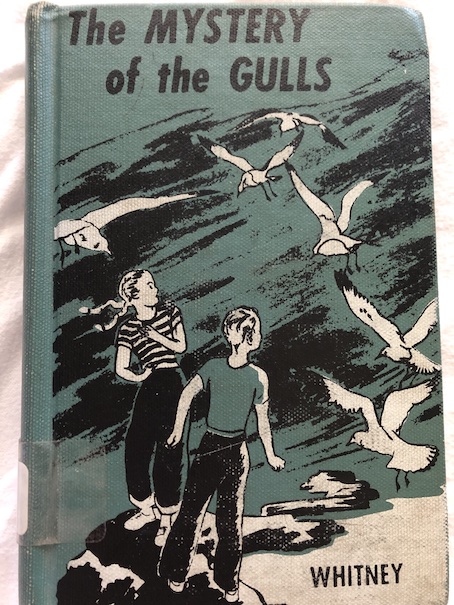
The Mystery of the Gulls by Phyllis Whitney, 1949.
Taffy Saunders and her mother are heading to Mackinac Island for the summer while Taffy’s father is in the hospital, recovering from a car accident. Taffy’s mother’s Aunt Martha has recently passed away, and she left the hotel she owned to Taffy’s mother. It’s a strange bequest because Aunt Martha hadn’t gotten along with her niece for years because she had disapproved of her marriage. There is also a condition on the inheritance. In order to retain ownership of the hotel, Taffy’s mother has to run it herself for a summer. Taffy thinks that it all sounds strange and mysterious, but her mother says that her aunt was an eccentric, and it was often difficult to understand why she did some of the things she did.
Taffy’s mother worries that something will go wrong over the summer that will prevent her from owning the hotel. It isn’t really that Taffy’s mother wants to be a hotel keeper, but since Taffy’s father’s accident, they’ve spent most of their money on medical bills. When he gets out of the hospital, he won’t be able to do his old job, which involved a lot of travel, so they’re going to have to settle down in a new city. Taffy is happy about living a more settled life than they used to live, but they’re going to need all the money they can get to buy a new home. Taffy’s mother is hoping to sell the hotel to pay their bills and buy a new home, but she can’t do that unless she can prove that she can manage the hotel first. Mrs. Saunders is hoping that her aunt’s long-time housekeeper, Mrs. Tuckerman, will help her make this summer a success, while Taffy is hoping that Mrs. Tuckerman’s daughter, Donna, will be a friend for her. Because their family has moved a lot, Taffy hasn’t had many opportunities to make and keep friends.
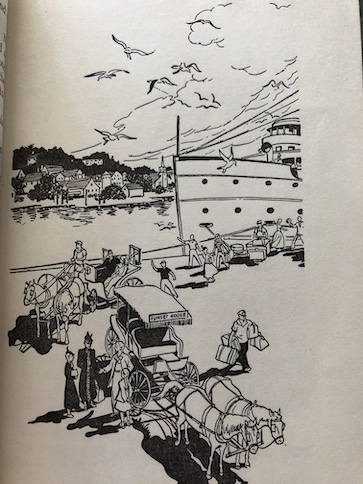
On the boat ride to Mackinac (which they point out is pronounced “Mackinaw” by locals), Taffy meets a boy about her age, David Marsh, who is going to Mackinac to visit his grandmother, and they talk about the sights to see on the island. There is an old fort on the island that is now a historic site for tourists, and David offers to show Taffy around. He tells her where his grandmother’s house is and says that she can come see him there, or he’ll come to the hotel, Sunset House, to see her.
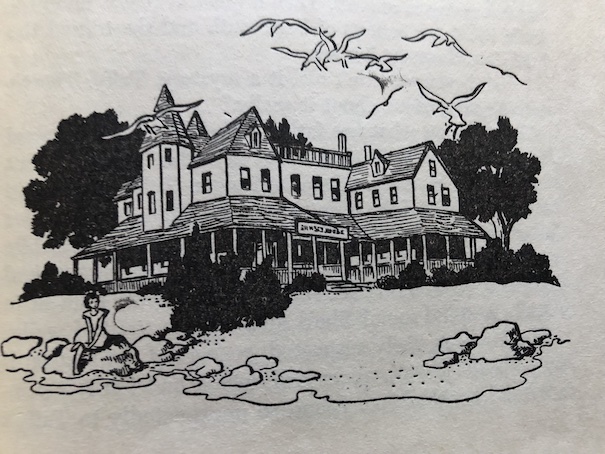
When Taffy sees Sunset House, she thinks it’s charming. The hotel is a large, old house with turrets, cupolas, and a widow’s walk. Mackinac Island in general seems charming. Cars are not allowed on the island, so people get around with horses, carriages, and bicycles. Taffy’s mother talks about wanting to “wake this place up”, but Taffy thinks that the calm, sleepy atmosphere is right for the house and doesn’t want to disturb it. Since Taffy has moved a great deal with her parents because of her dad’s job, she has lived in many hotels and apartments, and she finds the old-fashioned and comfortable furniture at Sunset House to be homey. Taffy thinks that the home-like atmosphere of Sunset House is a nice change and that she will like it there. The room she shares with her mother is beautiful, also filled with old-fashioned furniture and a charming alcove with a lovely view.
It seems like Aunt Martha’s usual guests prefer the place quiet, too. The first guests that they meet are the Twig sisters, a pair of elderly ladies who are at first concerned about a new child in the house. Until Taffy arrived, the only child at Sunset House was Donna, who is described as a quiet child. Aunt Martha only rented rooms to adults with no children. Taffy learns that Donna, who is about her age, is usually never even allowed to bring other children to visit her. Taffy feels sorry for Donna and hopes that she will want to be friends as much as she does.
Besides Mrs. Tuckerman, the housekeeper, there is also a cook named Celeste. When Taffy and her mother first arrive, they are told that Celeste hasn’t prepared lunch because she’s been seeing “omens.” Apparently, this is something that she does periodically, and Mrs. Tuckerman thinks that, this time, it’s just because she’s upset about Mrs. Saunders arriving. There are three other people who also work in the kitchen, but they all seem pretty useless without Celeste’s direction. Fortunately, Mrs. Saunders is a woman of action, so she immediately takes charge of making sandwiches for lunch. To speed things up, she even offers to let guests come to the kitchen to make their own sandwiches, any kind they want, if they wish to. Although Mrs. Tuckerman isn’t sure that will work, lunch turns out fine. However, Taffy has a strange encounter with Celeste in the garden.

In the garden, Celeste asks Taffy what word the gulls are saying. Taffy did have the feeling before that the gulls are saying a word, and it sounds like the word “help” to her. Celeste says that’s what she thought, and she says that’s a sign that a storm is coming. Her fear of the bad storm coming is why she feels like she can’t cook, and it bothers her that nobody else seems to understand, implying that there is impending doom. Taffy shows Celeste a map that David drew to his grandmother’s house, which she is having trouble understanding. Celeste explains to her how to get to the house, and she also mentions a shortcut, but she warns Taffy not to take the shortcut after dark because it goes through a “goblin wood.”
Taffy meets Donna for the first time at lunch. Donna is a shy girl, but she is glad that Taffy is there because she has spent much of her time alone since children are not usually allowed at Sunset House. Taffy asks Donna about Celeste and what she means about the “goblin wood.” Donna explains that Celeste and her family have lived on Mackinac for a long time because they are descended from fur traders (this is why Celeste has a French name, although the book doesn’t mention it directly) and Native Americans (the book uses the word “Indians”). Because of this heritage, Celeste has a lot of superstitions about the island and the spirits that supposedly inhabit it. Taffy doesn’t believe in spirits, but she can’t resist taking the shortcut to David’s grandmother’s house, just to see what it’s like. She has an odd encounter in the woods with a Native American boy (called an “Indian”) wearing overalls, who refuses to speak to her and seems hostile toward her.
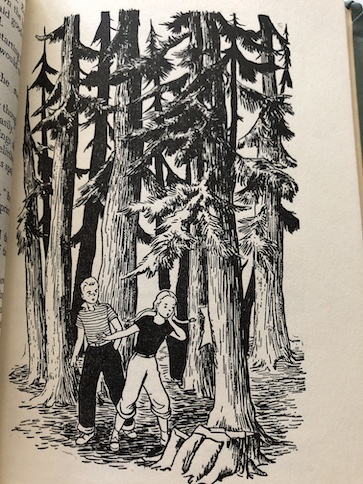
When Taffy sees David, she tells him everything about Celeste and her encounter in the “goblin wood.” David says that he’s taken the shortcut through the woods many times without a problem, and he never had any reason to think that it might be haunted. Taffy is a little insulted at his comment that maybe girls get scared easier than boys, and David explains that the boy might not have been as unfriendly as she thought because her imagination might just have been fueled by Celeste’s stories, so she was primed for something scary or sinister to happen. They reconsider that theory when the two of them walk back through the “goblin wood” and find a note left on a tree, telling her that she’s not wanted on the island and that her presence makes the “manito” angry. David says that the “manito” is one of the Native American gods or spirits who supposedly inhabit the island. (This is a real concept in Native American lore, but I’ve seen it spelled “manitou.”) Whoever wrote the note was trying to scare Taffy, but why?
David is intrigued by what Taffy has told him about Celeste and her “omens” and the “goblin wood”, the note left for Taffy, and the unfriendly boy in the overalls (who Taffy sees again, talking to Donna, when she and David try out his grandfather’s binoculars), and he says he is willing to help her investigate further. The two of them work out a code, where Taffy can hang things of different colors in the window of her bedroom to send him messages.
The mystery deepens when Taffy’s mother tells her that there are two vacancies in the hotel after Taffy heard Mrs. Tuckerman turn away a man who wanted a room. There is also a locked room off of Aunt Martha’s old office that Donna says no one is supposed to enter. She says that they can’t even find the key, that no one has seen it since Aunt Martha died. When Taffy talks to her mother, she says that the locked room is a library and that the boy in overalls she’s been seeing is named Henry and that he does odd jobs for the hotel. Taffy tells her mother that it seems like people don’t want them on the island, including Henry, Celeste, and Mrs. Tuckerman. Even Donna has been acting strangely. Even though she said that she was glad Taffy was there, she’s been strangely unfriendly, and she’s been telling her mother that Taffy is the unfriendly one! Taffy thinks that’s really unfair, but her mother thinks that it’s just because everyone is adjusting to the changes since Aunt Martha died. Donna isn’t used to being with other children, and Celeste and Mrs. Tuckerman may be worried about their jobs since the ownership of the hotel depends on how well Mrs. Saunders manages it this summer and what she plans to do with it when she takes full ownership. Taffy and her mother don’t even know what will happen to the hotel if Mrs. Saunders can’t prove that she can manage it well enough. Aunt Martha’s will deliberately keeps the alternate heir secret until the end of the summer.
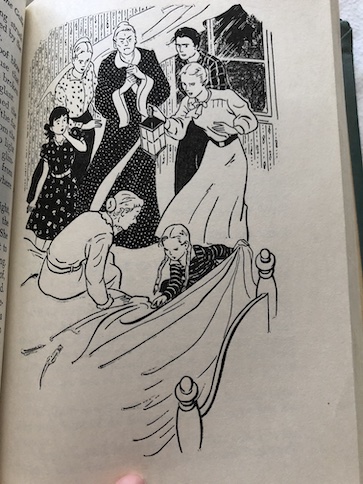
This is only the beginning of the mysteries and puzzles. Taffy learns that the man Mrs. Tuckerman turned away from the hotel was actually an old friend of Aunt Martha who has worked in hotels in Asia and says he would like to own a hotel of his own. The storm that Celeste predicted comes, and a baby seagull crashes into the window of the Twigs’ room. Celeste thinks that’s another bad omen and that Taffy and her mother should leave. Then, someone leaves a bat skeleton in Miss Twig’s bed. Donna says that Aunt Martha used to collect things like that and that maybe her spirit put the skeleton in the bed because she’s not happy. Of course, Taffy doesn’t believe that. Too many living humans seem unhappy that she and her mother are there. Donna admits that Aunt Martha was originally going to leave the hotel to her mother before the two of them had a quarrel, and Aunt Martha changed her will. Whether Mrs. Tuckerman might still be the alternate heir to the hotel is still unknown. Donna thinks the alternate heir might be some bird society because Aunt Martha was an amateur naturalist with a fondness for birds. Could there be another heir who is hoping to drive Taffy and her mother away so they can have the hotel? Could Donna and her mother still be hoping that the hotel will come to them? Could Celeste or Henry be trying to drive them away for their own purposes?
The book is available to borrow and read for free online through Internet Archive. Like other Phyllis Whitney books, this book is something of a collector’s item now, and copies are not cheap through Amazon.
My Reaction and Spoilers
I’ve been to Mackinac Island before, when I was in my teens, and I didn’t know about the pronunciation until I read this book. I had even forgotten about the horses and carriages since I’ve been there (which might seem odd, but I only spent one day there and I was obsessed with the fudge), but Mackinac Island is still car-free today. Reading this book revived some old memories for me, and it makes me want to go back and spend more time there! I didn’t stay overnight while I was there last time, but there are plenty of hotels there, including ones that resemble the one in the story, with turrets, cupolas, and widow’s walks.
Culture and Folklore
The book mentions that there are many Native Americans living on Mackinac Island, but it doesn’t mention a specific tribe. Even though some of the spooky and ominous things that happen in the story appear to have their roots in Native American folklore and superstition, I’m not completely sure how accurate the descriptions of the folklore aspects are. From what I’ve read, it seems that manitous (or manitos) really are a part of Native American folklore in that region, but there are a couple of aspects of it in the story that I haven’t been able to verify. As a slight spoiler, we eventually learn that Aunt Martha used to collect not only animal skeletons but dead birds, which she would turn into taxidermy. Celeste didn’t think that this was fully respectful to the spirits of the creatures, although she did seem to think that Aunt Martha had some kind of special connection to the spirits of birds because she was so good with them, living, injured, or dead. Because the author, Phyllis A. Whitney spent her youth in Asia because of her father’s job, she also has a habit of introducing Asian elements to most of the books she wrote at some point. In this one, although the main focus is on aspects of Native American folklore, there is also an Asia folklore story about a Chinese gong in the hotel, which seems to have a connection to birds or winged creatures, and that complicates the situation. The effect is that Taffy sometimes feels like she is dealing with forces that she doesn’t understand, which adds some suspense, although she is also sure that there’s a person behind it all because she doesn’t really believe in all the folkloric superstitions and physical objects are being used for the strange things that are happening.
One thing that I like about Phyllis A. Whitney’s juvenile mysteries is that they do frequently include history and folklore of different places and people around the world, and they do seem generally well-researched and presented with empathy. This book and other she wrote were published in the middle of the 20th century, around the same time that other books I’ve read were also published. Some mid-20th century books for kids lean into racial or cultural stereotypes, but Whitney’s book often subvert that or show characters rethinking some of their preconceived notions. The book does use the word “Indian” instead of Native American, which isn’t preferred, but apart from that, Taffy’s attitudes and ability to look at things from someone else’s point of view are good. Taffy is characterized as a very imaginative girl, and one of the ways she uses her imagination is to picture what other people think or how they would feel about different things. At one point, David says that Celeste is crazy for all of her superstitious talk, but Taffy defends her, saying that she’s not crazy. Taffy doesn’t believe in Celeste’s superstitions, but she recognizes that Celeste believes and acts the way she does because she has spent her whole life being steeped in stories of the history of spirits. These stories don’t make sense to Taffy and David, but Taffy recognizes that they make sense to Celeste. Celeste is wrong about the spirits being responsible for everything weird that’s happening, but being wrong about something isn’t the same as being crazy.
Later in the story, the kids form a club for exploring the island and giving hotel guests tours of some of the scenic spots. Taffy, David, and Donna ask Henry to be their “Indian guide” for the tours, and Henry sarcastically asks if they’re expecting him to wear feathers. The others quickly reassure him that they’re not asking him to be the guide because they want him to put on a kitschy show for the tourists or anything embarrassing like that. They just think he would make the best guide because he knows the island better than the rest of them and all the history and stories of the island. They want to call him an “Indian guide” to emphasize his Native American heritage and provide a credential for his knowledge for the sake of the tourists, but they say they would still want him to be part of the tours even without that, just because they want to be friends and include him. This explanation satisfies Henry, and he joins their tour club. For those who would like to learn more about the history of real Native American life on Mackinac, I recommend the Biddle House Native American Museum.
Time Period and Atmosphere
This book is set contemporary to when it was written, the in late 1940s. Readers will notice that Taffy periodically mentions whether or not women are wearing slacks instead of skirts, and that’s because that was a modern fashion trend in her time. Taffy’s mother is very much a modern woman, and she wears slacks from the beginning. However, Taffy can see that many women who stay at Sunset House (although not all) are older and more old-fashioned women, who wear skirts, like the Twig sisters. At first Taffy worries about whether her mother is dressing appropriately for her new job, managing the hotel, but it works out fine.
Taffy and her mother have different views on the hotel from the beginning. Taffy thinks that the old-fashioned hotel is charming and that the quiet atmosphere really suits the place. However, Taffy’s mother thinks that the place seems depressing and wants to “wake it up” a little. Taffy worries that her mother’s attempts to “wake it up” might ruin the quietness and quaintness that appeals to their customers. This is one of the reasons why people who work at Sunset House are concerned about what Taffy’s mother plans to do with the hotel. On the one hand, they didn’t always like the way Aunt Martha did things, but Taffy’s mother is a newcomer, who might not understand which parts of the hotel’s atmosphere should be preserved.
It’s true that people often visit places like this hotel specifically for their atmosphere, and the kind of people who choose to stay at Sunset House are looking for exactly that quiet and quaint atmosphere. When she was alive, Aunt Martha cultivated that time of atmosphere and a client base who likes that. With Aunt Martha’s death, Sunset House is at a transition point, where the new ownership will set the tone for its future. I think Taffy is right that the old-fashioned charm of the house should remain because even modern people like to visit quaint and charming places that are very different from the places where they live the rest of the time, but at the time time, Aunt Martha’s ways were unnecessarily strict, and there is some room for relaxing the atmosphere without ruining the quaintness. Allowing families with children wouldn’t be bad, and when Taffy’s mother learns that Donna’s passion in life is dancing (something that Aunt Martha disapproved of), she arranges for Donna to do an evening show for the guests, which Donna and the guests love. A little live music and dancing is a way of adding some life to the old house without ruining the charm because Donna’s ballet and tap dance are also charming and tasteful.
For some context between Taffy’s mother and her Aunt Martha, I’d like to point out that, because this book takes place in the late 1940s, Taffy’s mother’s youthful visits to her aunt’s Mackinac Island hotel took place before her marriage, which was probably in the mid-1930s, given Taffy’s age. That means that she was there as a kid during the 1920s or early 1930s. Culturally, the 1920s and 1930s, post-WWI, was the beginning of the modern era, with flappers pushing the boundaries of women’s dress and behavior, and women needing to take on greater roles in working and supporting their families during the Great Depression and WWII. Taffy’s mother would have been growing up, coming of age, and marrying and having a child of her own during all of these changes, and I think this helps explain her practical, modern outlook on life and personal habits. (Remember, she wears slacks. Other women don’t, especially the older and more traditional ones.) As a member of the previous generation, Aunt Martha would have been a product of the late 19th century and early 20th century, which I think helps explain the Victorian/Edwardian style of her home and her apparent attitude that children should be seen and not heard, an attitude which seems to be shared by the Twig sisters. Not all Victorian era adults felt this way, and many parents genuinely loved and indulged their children whenever they could, but it seems like Aunt Martha clung to the strict aspects of Victorian upbringing. In fact, her resistance to listening to the needs of the young people is a central part of the mystery. In fact, it is the reason for the mystery, and we learn that Aunt Martha’s behavior wasn’t solely a matter of her upbringing but her own mercurial personality and moods.
Aunt Martha (Spoilers)
Understanding Aunt Martha is key to understanding the entire mystery because she is literally the one who set everything up. Although she is dead before the story begins, we actually do get more explanations of her thinking in her own words than almost anyone else, except for Celeste, because she left behind journals that explain everything. I got angry with Aunt Martha when I realized that her manipulation of everyone was deliberate and planned. Aunt Martha wasn’t just strict; she was controlling and vindictive. She expected everyone to consult her about everything going on in their lives and to do everything she said, just based on her say-so. Whenever anybody resisted that control because their lives were their business and not hers, she would get angry, and that’s when she would withdraw affection and support and renege on promises she had made, seeking to punish them for their resistance. As Taffy later observes, Aunt Martha was not a nice person, and in her journals, she even said that she distrusted people who were too nice and too liked by other people because she never was herself. Her hotel was charming, but she wasn’t.
The terms of Aunt Martha’s will were not so much designed to benefit someone as to punish them all. She didn’t leave the hotel to Mrs. Tuckerman, as she had originally planned, to punish her for not following her orders on how to raise Donna, even though Mrs. Tuckerman had previously let her control things for both her and Donna. Leaving the hotel to her niece wasn’t meant as a nice gesture, either. She thought her niece was an idiot whose decision to marry a man she didn’t approve of was a sign of ingratitude for all that she had done for her (whatever that was – apart from letting her visit during summer, we don’t know of anything else she did), so she expected that she would fail at managing the hotel and would be publicly embarrassed by the failure. Aunt Martha purposely set up a situation where some people would have to ensure that others would lose in order to “win” something because she liked the thought of them fighting among each other and having problems because of her.
While understanding other people’s thinking is important, I also think that it’s important to recognize that understanding does not equal approval. We can understand that Celeste’s superstitions make sense to her without believing that everything has a supernatural cause, and we can also understand why and how Aunt Martha decided to use her will to get back at everyone for defying her in some way while recognizing that everything she did was toxic and done out of malice. What eventually stops it all is the revelation of Aunt Martha’s thinking and the understanding of the motives of the people doing all the strange things at the hotel. Taffy and one other person realize that, in spite of Aunt Martha’s manipulation, there is still a way for everything to work out well for everyone, with no “losers” in the situation. Once they figure that out, they are able to explain things to the others and get them to cooperate.
There is a theme in the story about good people who do bad things, but that applies more to the people Aunt Martha manipulated than Aunt Martha herself. Aunt Martha was good to birds and helped them heal when they were injured, but she wasn’t so kind to her fellow human beings. Some of the characters in the story think that they have no choice but to do what they’re doing because of the way Aunt Martha set things up, and it’s very hurtful to Taffy because she thought they liked her and she liked them, yet they were plotting against her and her mother the whole time. Taffy’s mother says that they did like them and feel badly about what they did, that they just felt trapped. I was bothered by some of the characters talking about how likeable these characters were because I don’t like people letting others off the hook for doing harmful things just because they can be pleasant and charming sometimes. There are serious abusers who too frequently get off the hook for those reasons. Heck, people let Aunt Martha get away with many of the things she did because she was nice to birds and could be charming and helpful sometimes, but her journals explain detail how little she thought of other people and how she schemed to manipulate and control them. Her last act was to do something she knew would hurt and embarrass the people close to her and cause them problems with each other.
Fortunately, even though the offenders are otherwise nice and likable, the book doesn’t let them off the hook for their behavior. I was gratified that Taffy’s mother and other characters say that people need to take responsibility for their choices, even if they’re “all mixed up inside”, and that doing things that harm others can’t be excused. Even the miscreants just saying that they understand now that they were wrong about what they were thinking and doing doesn’t get them completely off the hook. Instead, the characters make the offenders each pick a way to punish themselves and make amends for the trouble they’ve caused, to show everyone that they’re genuinely sorry and really mean to make things right. I like it because, as Taffy points out, their behavior makes her wonder about their entire relationship. How much of their previous likeability was just an act while they were scheming against them behind their backs, and what is their relationship going to be now? Can they still be friends, or is that all over because they were plotting harm the entire time? The punishments they give themselves are a gesture to show that they really do regret what they did and that they are going to follow through on that regret and change for the better. Nobody gets away with causing problems just because they put on an outward show and come across as likeable. In the end, they’re not trying to insist on everyone letting them go because that’s what they want, and they’re not acting as though they’re entitled to anything or deserving of being treated as special exceptions. It’s just them, taking responsibility for themselves and owning their feelings and motivations, as Aunt Martha never fully did outside of her journals. As Mrs. Saunders says, “like anyone who does wrong, they’ll have to take their punishment.” Their willingness to do that and to admit that they were wrong and make amends is what paves the way to repairing their relationships with the others.
I was disappointed, though, that we don’t really get to see the miscreants explain themselves. The Taffy’s mother and others talk to them without Taffy being present, saying that they want to handle the matter privately, even though Taffy is the main character and the one who was investigating the mystery all along. It’s sort of weird that the main character was shut out of the final discussion. Because she’s not there, readers don’t get to “see” exactly what happened or hear the miscreants’ explanations in their own words. Taffy’s mother just tells her about it afterward, and that feels like a cheat. “Show” is generally better than “tell.”
A Touch of Cottagecore

I think this mystery story about a summer spent in an enchanting place, with an old-fashioned hotel and an island with horse-drawn carriages, might appeal to fans of the Cottagecore aesthetic. The kids in the story have some independence in where they go and what they do. Taffy is allowed to spend some time exploring the island with David, seeing the sights and enjoying the beauty of the island. The garden around the hotel has pretty flowers, and Taffy starts learning some of their names. She never had the opportunity before to learn much about flowers because she’s been living in hotels and apartments. She thinks that, when her family finally has their own house, she also wants her own garden with flowers.
Some characters in books make up their own special words which are only used in their story, and the word for this book is “exasper-maddening”, which Taffy and her father use to describe her mother’s behavior at times. The mother is a woman of action, which can be good when someone needs to take charge of the situation. However, she is also impulsive and stubborn, given to doing things as soon as she gets the notion to do them and sweeping everyone else along with her, and she also has a tendency to focus on whatever seizes her attention in the moment instead of what’s concerning someone else.
 Jestress's Forgotten Books and Stories