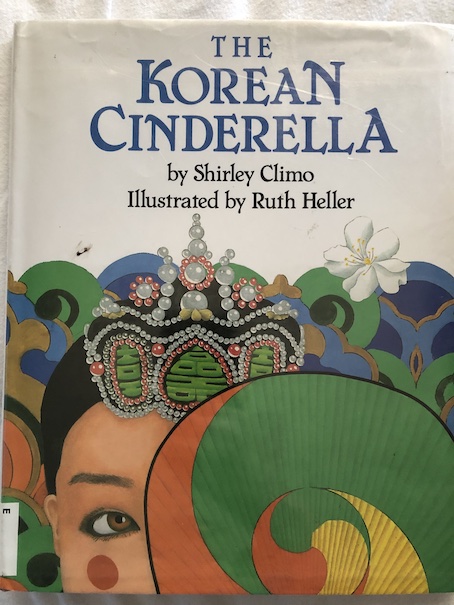
The Korean Cinderella by Shirley Climo, illustrated by Ruth Heller, 1993.
In this Korean version of the classic Cinderella story, a couple who live in a little cottage have a daughter they call Pear Blossom. Pear Blossom is a lovely girl, and when her mother dies, her father thinks that he should remarry, so he will have a wife to help care for his daughter.
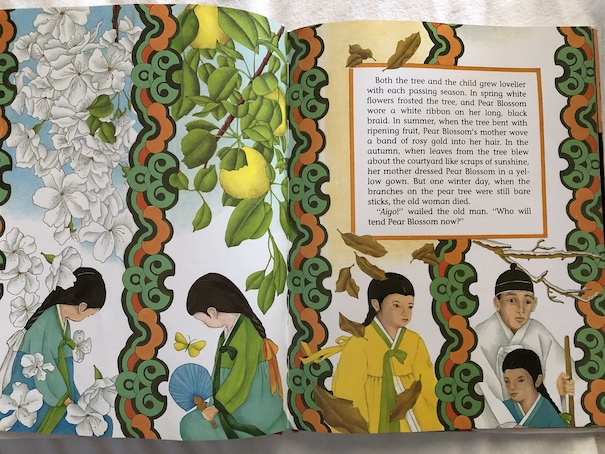
The village matchmaker matches him with a widow who also has a daughter, a girl called Peony. However, after the marriage, it becomes clear that Pear Blossom’s new “mother” doesn’t like her, and her new “sister” doesn’t either. Her stepmother and stepsister are jealous of her, so they nitpick everything she does and make her do all the chores. As Pear Blossom’s father’s health worsens, he is less able to interfere with their mistreatment of Pear Blossom, and the stepmother schemes to find a way to get rid of Pear Blossom entirely.
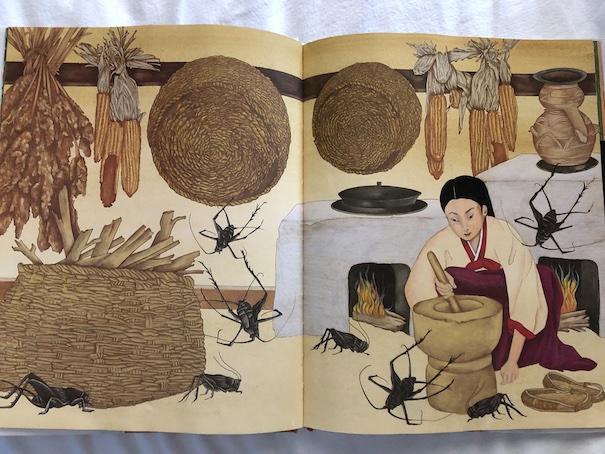
The stepmother keeps assigning Pear Blossom chores that she thinks will be impossible for her to complete, but various animals take pity on her and help her. A frog helps her to fill a jug that has a leak by plugging the leak, and some sparrows help her to hull a massive amount of rice.
One day, Pear Blossom’s stepmother and stepsister go to a festival in the village, leaving Pear Blossom at home. The stepmother says that she can only go to the festival if she weeds the rice paddies first. However, a huge black ox appears out of a whirlwind and takes care of the task for her!
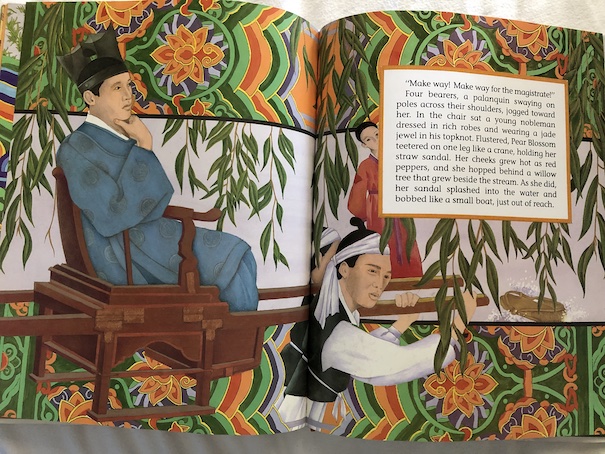
On her way to the festival, Pear Blossom sees the handsome magistrate but accidentally loses one of her sandals as she gets embarrassed and runs away. The lost sandal helps the magistrate to find Pear Blossom at the festival, and he declares that he wants to marry her.
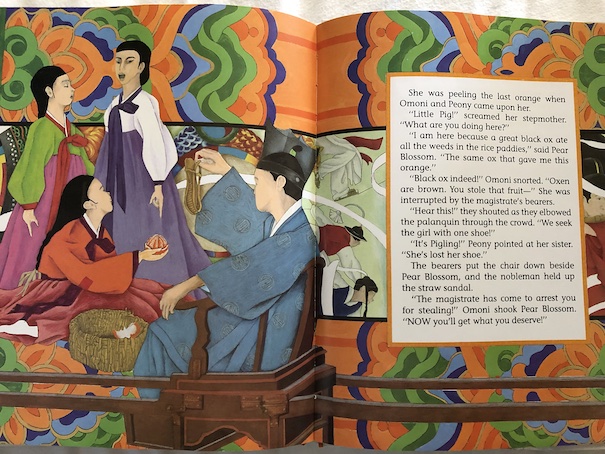
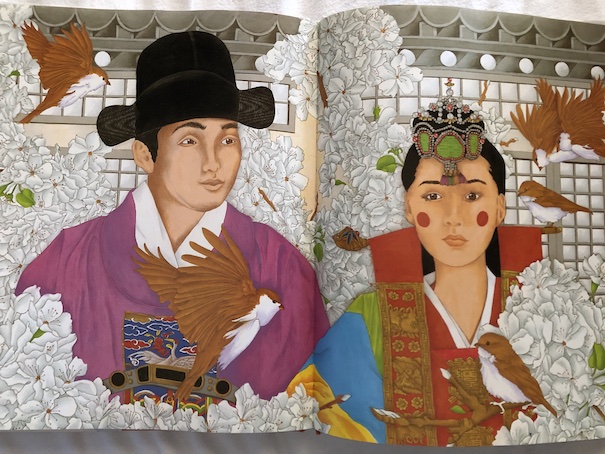
There is an Author’s Note in the back of the book about the background of this fairy tale, and the author notes that there are multiple Korean versions of this story. There’s also an Illustrator’s Note that discusses the style of the illustrations. It explains about how designs that appear in the illustrations are based on designs from Korean temples, and there is also information about the clothing the characters wear.
The book is available to borrow and read for free online through Internet Archive.
My Reaction
Shirley Climo has written multiple picture books about versions of the Cinderella story form around the world, and it’s fascinating to see how a story that so many of us recognize varies from country to country while still maintaining the same basic pattern. An aspect of this particular version of the story that Climo explains in her Author’s Note is that the animals that help Pear Blossom in the story are sent by a kind of “goblin” called a tokgabi or doggabi. The story itself says this, but in folklore, this kind of “goblin” can represent the benevolent spirit of someone who has died. In this story, the spirit might be Pear Blossom’s mother. This explanation makes sense to me because I remember reading something similar about the Chinese version of the Cinderella story. The story of Rhodopis, which Climo retold in The Egyptian Cinderella, may be the oldest form of the Cinderella story, and it doesn’t have that element of the girl’s deceased mother helping her through trials until she finds happiness, but it does put the concept of the Fairy Godmother from European version of the story in a different light.
This is another children’s picture book where I appreciated the notes from the author and illustrator because they add more depth to the story. When I was a kid, I never read notes like that because I was only interested in the story itself, but notes like this make the book more appealing for older readers.
 Jestress's Forgotten Books and Stories
One thought on “The Korean Cinderella”