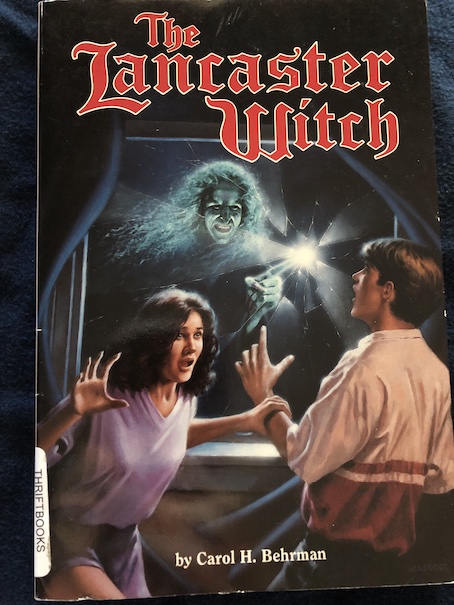
The Lancaster Witch by Carol H. Behrman, 1993.
Thirteen-year-old Maddie Stoner is startled when her parents suddenly tell her that she has an English cousin named Clive who is going to be arriving for a two-week visit on Saturday. Maddie has never even heard of Clive before and wants to know who he is and what’s behind his sudden visit. Her parents explain that Clive is more like a second or third cousin, the son of her mother’s cousin, who moved to England years ago and married a British man. Her mother’s cousin has only occasionally kept in touch since her marriage, but her son, Clive is just a little less than a year older than Maddie and wants to visit the US. His mother has asked Maddie’s mother if she’s willing to have him at their home in New Jersey this summer, and her mother said yes.
Maddie gets the feeling like there’s something more behind this mysterious cousin’s visit than her parents are admitting, but they dodge her questions on the subject. When she tells her friend, Chloe, about her cousin, Chloe theorizes that maybe Clive is some kind of juvenile delinquent or is otherwise in trouble or into something his parents don’t approve of, so they want to send him overseas to get him away from his problems. (Chloe says that she read somewhere that people in England use the term “teddy boy” to describe boys involved in gangs. I looked it up, and it seems to be an older term from the 1950s and 1960s. It seems more associated with the aesthetic of certain types of rock and roll fans, although there were gangs associated with it as well. It’s just kind of an old concept for a 1990s book.)
When Maddie and her parents go to meet Clive at the airport, Maddie sees a creepy woman in black with a very pale face following Clive, her hand on his shoulder. Then, a traveler hurrying past accidentally bumps into Maddie with his suitcase and knocks her down. When she gets up and looks around, the woman is gone. She asks Clive who the woman was and where she went, and he says that there’s nobody with him. Maddie’s parents think she was just mistaken, that she just saw another traveler who happened to be near Clive at the time. Maddie is sure that she wasn’t mistaken, but Clive refuses to acknowledge that the woman in black was with him and her parents don’t want her to keep talking about it.
As Maddie and Clive start getting to know each other, Maddie decides that she likes Clive. Neither of them has any siblings. Clive and his parents live in a resort town called Morecambe outside of Lancaster in northern England. When Maddie asks Clive what made him want to visit the US, he’s a little evasive, just saying that his mother thought it would be good for him to get away for a while, making Maddie more suspicious that there’s something about Clive that no one wants to tell her. However, they discover that they have similar tastes in music, and when Maddie invites him to come to the community pool with her and her friends, Clive eagerly accepts, saying that he likes to swim.
At the pool, something happens that convinces Maddie that something truly sinister is happening. Clive and her friends all go swimming while Maddie takes some time to sun herself. Maddie is dozing in a lounge chair when someone starts yelling that someone is drowning! Clive is the one who almost drowns, but fortunately, he is rescued in time by the lifeguard. When he’s pulled out of the water, he tells Maddie that “she” pushed him into the water and made him hit his head and that “she” almost killed him. When Maddie looks around to see who “she” is, she sees the woman in black leaving the pool area. However, when the lifeguard starts asking Clive questions, he changes his story, saying that he just made a clumsy dive and hit his own head. Maddie later confronts him about what he told her, saying that she saw the woman in black, but Clive just gets upset and denies it all.
Maddie talks to her mother, and her mother confirms that Clive’s mother said that he’s been having a few problems lately that he needs to get away from. Clive’s mother was vague about what kind of problems Clive has been having, and Maddie’s mother assumes that Clive’s problems are just typical kid problems. She discourages Maddie from talking it about with Clive because she wants his visit to be pleasant and doesn’t want him to be upset.
Still, Maddie suspects that something much more serious is happening with Clive. Unable to shake the feeling that something bad is happening and that Clive is in real trouble, she snoops in his belongings, finding a letter that he started writing to his parents, saying that “it” followed him to the US. Clive also has books about ghosts and has written some notes about ghosts. Maddie wonders if Clive could be crazy, but she saw the woman in black herself. Clive’s panicked notes about ghosts might not be the imaginings of an unbalanced person but the reasonable fears of a person experiencing something truly unearthly.
Eventually, Maddie gets Clive to admit that the woman in black exists, but he refuses to tell her more about it until she promises that she won’t tell anyone else. Maddie promises, and Clive tells her that it’s the Lancaster Witch. In the 1600s, a group of women were executed for witchcraft in Lancaster, England. One of them, a woman named Elizabeth Device, was supposedly the head of a family of witches, and she cursed the judge in the trial and his descendants. Clive is one of those descendants. He’s been aware of her presence, following him around for about a year, and that was why he wanted to leave England, hoping to get away from her. His parents don’t seem to see her, so he hasn’t been sure whether she was real or just a ghost in his imagination. There have been stories about people in his family being haunted, but his father thinks that’s just superstition. Even though Maddie assures Clive that she’s seen the Lancashire witch, too, and that he isn’t imagining things, Clive says he can’t be sure. Maybe his imagination is now influencing her imagination.
For a while Maddie is persuaded that maybe the woman in black is all their imagination, and she tries to distract Clive from thinking about it. However, everywhere they go and everything they do, she always seems to be lurking around them, causing bad things to happen. She shatters a mirror in Maddie’s room at night and shoves Clive down the stairs. When Clive goes out for a bike ride with Maddie’s friend Tommy on a day when Maddie isn’t feeling well, he mysteriously disappears. Everyone assumes that he just got separated from Tommy and got lost because it’s an unfamiliar town for him, but Maddie is sure that it’s the ghost of Elizabeth Device and her curse!
As they search for Clive, Maddie and Tommy have to confront some truly dangerous things, both conventional and supernatural. There is a real ghost in the story, but there is also a more conventional form of danger. Dealing with the physical danger provides a solution for ridding Clive and his family from the curse of the Lancaster witch forever.
My Reaction and Spoilers
I remember reading this book when I was about 10 or 11 years old. A friend of mine had a copy, and I borrowed it from her. I remembered that I really liked it, but I had forgotten many of the details over the years. Now that I’m an adult, I understand more about the history behind the events in the story than I did as a kid. As a kid, I knew about witch trials, so I understood the basic concept behind the witch’s ghost, but I now know much more about the specific witch trial the story references.
There is a note in the back of the book about the historical basis for the story. In 1612, ten women were hanged for witchcraft in Lancashire, England, in front of Lancaster Castle, including Elizabeth Device. There have been many non-fiction books written about this case, and there are video documentaries on YouTube about the Lancashire witches, also known as the Pendle witches or Pendle Hill witches. One of the more shocking elements of that witch trial was that Elizabeth Device’s own nine-year-old daughter, Jennet, testified against her.
In the story, when Clive and Maddie are discussing the witches and witchcraft trials, they compare the Lancashire witch trials to the Salem witch trials, although Clive is wrong about the Salem witches being burned to death. It’s sloppy scholarship on the part of the author. The notion of witches always being burned is prevalent in popular culture, and it makes for dramatic scenes in movies, but that’s not how it went in real life, at least not in Colonial American. Nobody was burned in Salem because it was a British colony, and the British punishment for witchcraft was hanging, like in the Lancashire trials. Most of the Salem “witches” were hanged, and one person was pressed to death. It’s been a pet peeve of mine to point that out since I did some reports about witchcraft trials in college. It’s one of the first things people get wrong about Salem when they haven’t really researched the events there.
Maddie and Clive discuss some of the motives people had for accusing others of witchcraft, which could vary from suspicion that a neighbor was causing misfortunes to outright spite against someone they hated or envied for other reasons. Clive says that some of the people accused and executed for witchcraft believed that they were actually casting spells themselves. Whether they actually could do magic or if they were actually just following old superstitions is debatable, and Clive acknowledges that. Of course, since this is a ghost story with a witch’s ghost, the presumption here is that the witch had some kind of real power.
The story is suspenseful, but it has a good ending. Most people don’t know that the ghost is real, and they think that the danger Clive is in comes from another source. There is a conventional source of danger in the form of some criminal activity. Dealing with that situation helps to resolve the matter of the witch’s ghost because the ghost decides that Clive has repaid her family for what happened during the witch trial.
In the story, Maddie and her friends enjoy talking with Clive about differences between American and British teenagers, and they point out the differences in the ways each of them talk. Maddie also wonders if British kids play Monopoly, and the book says that she and her friend Tommy teach Clive how to play. However, I know that Britain has had its own versions of the game of Monopoly for decades, long before this story was written, so Clive should have at least known the premise of the game, even if he didn’t usually play.
 Jestress's Forgotten Books and Stories