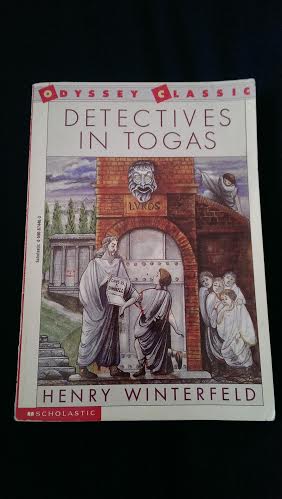
 Detectives in Togas by Henry Winterfeld, 1956.
Seven Roman boys, all the sons of wealthy families, attend the school run by the Greek mathematician and scholar, Xanthos. Although the boys are proud of their school, the lessons are sometimes boring, and everyone has given Xanthos the nickname Xantippus, in reference to the wife of Socrates, who was known for her nagging.
During a rather boring lesson on Greek vocabulary, a fight breaks out between two of the students that ends up creating a strange mystery for all of them. Caius was poking Rufus with his stylus, so Rufus wrote “Caius is a dumbbell” on the wax tablet where he was supposed to write his lesson. The boys get into a fight, and when Xantippus breaks it up, he sends Rufus home with the threat that he will expel him from the school.
 The next day, when the other boys arrive at school, they discover that their teacher has been attacked and robbed during the night. Worse still, when they go to Rufus’s house to visit him, they learn that someone has written “Caius is a dumbbell” on the side of the Temple of Minerva, which has been dedicated to the emperor. Defacing a temple is a crime, and soon Rufus is arrested and sent to prison (being young and part of an important family does not guarantee him special treatment). Rufus swears that he was not the one who defaced the temple, but who else could have done it?
Rufus disappeared that night, but if he didn’t go to the temple, where was he? Does the vandalism have anything to do with the attack on their teacher? The key to the mystery seems to be a mysterious soothsayer with ties to some of the highest officials in Rome. Something sinister is happening in Rome, and the boys are the only ones who can discover what it is!
This story was inspired by a piece of graffiti found during excavations of Pompeii in 1936. (This video doesn’t actually show the Caius inscription but similar types of graffiti, including ones done by children. I keep looking for the Caius graffiti, but I can’t find pictures of it. This video of a lecture at the Western Australian Museum about ancient graffiti in Pompeii shows the more graphic adult kind of graffiti with swear words, if you’re interested.) In ancient Pompeii, someone wrote “CAIUS ASINUS EST” on the wall of a temple, which basically means “Cauis is a dumbbell” (or similar type of insult) in Latin.
Although the book was originally from 1956, it was also originally written in German. I have a later reprinting that was translated into English. The book is available to borrow and read for free online through Internet Archive. There is a sequel called Mystery of the Roman Ransom.
 Jestress's Forgotten Books and Stories
Just read this book to my kids. It’s not the greatest read, probably because it is a translation. The sentences are very choppy and awkward. The names are long and yet all sound very similar to one another. The plot is slow and hard to follow.
LikeLike
I know what you mean. I thought this one was a much easier read than Emil and the Detectives, which is also a translation from German, but there is an art to translation, and some translators are much better at capturing the idiomatic expressions and general feel of a language than others. I did like this story for the soothsayer’s secret identity and the secret of where Rufus really spent the night in question. There is a sequel to this book, but I think the first one is really the better of the two.
LikeLike