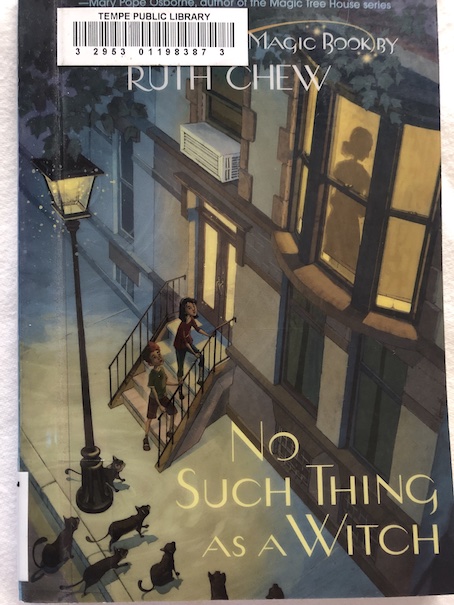
No Such Thing as a Witch by Ruth Chew, 1971, 2013.
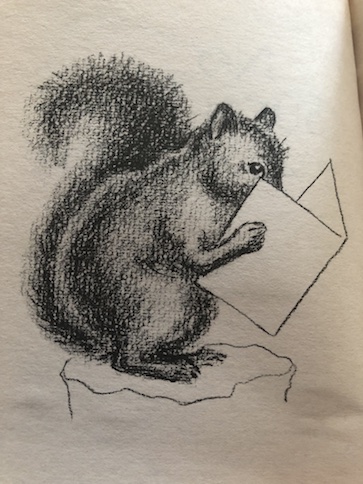
A new neighbor moves into one of the apartments in the brownstone next door, and the first sign that Nora and her brother Tad notice that this new neighbor isn’t a normal person is when they spot a squirrel who appears to be reading a tiny newspaper. The “newspaper” turns out to be one of the neighbor’s business cards. Maggie Brown has a business taking care of people’s cats and other animals. She seems to have a strange ability to communicate with animals and get them to do what she wants.
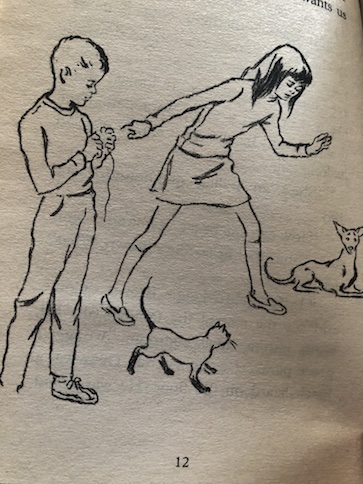
Nora begins to suspect that Maggie Brown might be a witch when she seems to communicate easily with their dog and when her brother starts getting along with Maggie’s cat, Henry, when he normally doesn’t like cats. The secret turns out to be Maggie’s fudge, which she says she makes from an old family recipe. A person who eats one piece loves animals, even if they didn’t before. Two pieces allow a person to talk to animals and understand what they say.
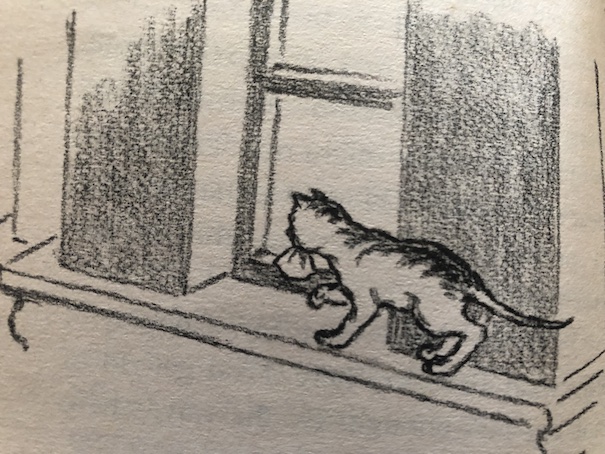
Tad has little restraint when it comes to the fudge, and when he eats too much, the kids understand just how powerful the fudge really is. Eating three pieces makes a person act like an animal, and four pieces will turn the person into whatever animal they were thinking of at the time. Tad accidentally turns himself into a cat, and Nora has to help cover for him until he turns back into himself. The effects of the fudge are always temporary, no matter how many pieces a person eats, so Tad doesn’t suffer any ill effects.
The children are intrigued by Maggie Brown and become friends with her, although Nora is unsure at first how much they can trust her. She is sure that magical Maggie must be a witch,her fudge can cause problems when their animal escapades go too far, and she doubts whether Maggie is even taking care of her animals when she finds that Maggie has been plucking out a bird’s feathers. She changes her mind after a trip to the zoo, where Nora learns that the bird has a problem with its feathers and Maggie has only been plucking out the bad ones to allow new ones to grow.
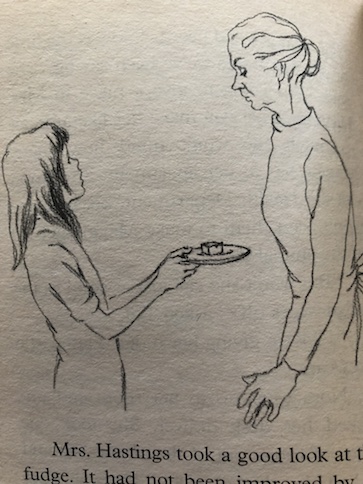
However, other people have problems with Maggie. A local shopkeeper resents Maggie after she confronts him about a cat he tried to abandon, and her landlady, who is not an animal lover, becomes concerned about the animals she’s been keeping in her apartment. When the landlady decides to call the health department and get someone to inspect Maggie’s apartment for health violations, Nora and Tad decide to see if they can turn her into an animal lover with the help of Maggie’s fudge.
The book is available to borrow and read for free online through Internet Archive (multiple copies).
My Reaction
It’s a fun story about a magical neighbor and her magical fudge, which allows people to talk to animals or even turn into animals, if they eat enough. The two kids in the story enjoy having a little magic enter their lives in their otherwise ordinary neighborhood. Maggie never actually admits to being a witch, but she comes to realize that the kids understand that her fudge is magical, and she trusts them with the secret. The adults in the story never figure it out, even though some of them also eat the fudge.
Although the effects of the fudge are temporary, they do help change people’s attitudes about animals even beyond when the effects wear off. Tad continues liking Henry the cat after he gets used to him, and Nora develops better feelings for Maggie’s pet lizard once she gets to know him. The fudge allows them to get to know the animals better, look at them in a different light, and generally give them a chance. The kids hope that, once the landlady has had some samples of Maggie’s fudge, she will also develop better feelings for animals over the long term.
One other thing I wanted to mention is that, while the kids refer to Maggie casually, their mother is always trying to correct them, insisting that they call her Mrs. Brown instead, because she’s an adult. It’s traditional for children to address adults in a formal way as a sign of respect, although people in general have become much more relaxed about that. When I was a kid in the 1980s and early 1990s, I was always taught to refer to adults formally, by last name, although when I was in college in the early 2000s, that habit weakened. I had professors who preferred to be called by their first names, in spite of their academic credentials, and friends’ parents starting wanting to be called by their first names. People in Arizona are largely informal anyway, and many people even have business acquaintances call them by their first names. As a now middle-aged adult in the 21st century, I also prefer people to call me by my first name, partly because I feel more relaxed with the informality, partly because it’s what I’ve been called for most of my life, and also because my last name is a little long and some people find it difficult. I don’t care if kids even call me by my first name because that’s just who I am, and I think they probably have an easier time if they just think of me by first name.

