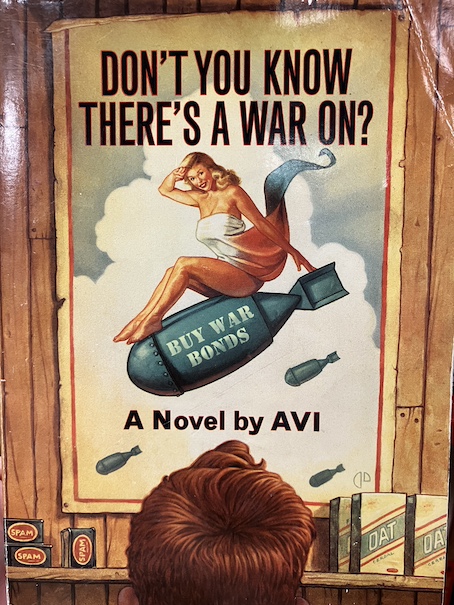
Don’t You Know There’s a War On? by Avi, 2001.
In 1943, 11-year-old Howie Crispers lives in Brooklyn and goes to public school. Although he’s still a kid in school, every part of his life and every part of the lives of people he knows, like his best friend, Denny, has been impacted by WWII. Howie’s father is in the Merchant Marines, which means that he’s away most of the time, taking supplies overseas. Howie never knows exactly where his father goes because people aren’t supposed to talk too much about the movement of people and supplies for the war. The phrase “Loose lips sink ships” has special meaning for Howie. When letters from his father arrive, they arrive censored, with pieces of important information cut out of them, so Howie’s father can’t accidentally give away information that might potentially be important to an enemy if the letter was intercepted or if his family mentioned things that they shouldn’t from his letters.
Denny’s father is in the army somewhere in North Africa, and other classmates have fathers or brothers overseas or family members involved in war work in some way within the United States. The kids also participate in volunteer activities related to the war effort, like gathering useful scrap materials that can be made into supplies. Many things are rationed, and people can’t always get what they want. Sometimes, there are blackouts and air raid drills. Whenever someone has to make do with things as they are or put up with abnormal situations, they tend to shrug it off and say, “Don’t you know there’s a war on?” Howie’s noticed that phrase seems to be an excuse for a lot of things.
Howie and Denny, like other kids, love listening to plays on the radio, and popular entertainment also frequently focuses on the war. Howie and Denny are especially fascinated by stories of spies, and they start wondering if there could be spies around them even now. Their primary suspect for being a spy is their school principal, Dr. Lowminster. With most of the men they know away fighting or working in some capacity related to the war, they wonder why he isn’t also in the armed forces or doing some kind of war work. Dr. Lowminster is a strict man, and when Howie spots him leaving the school one morning just as classes are about to start, he realizes that this is something out of character for him and his usual routine.
Skipping class himself, Howie follows Dr. Lowminster and overhears a conversation between him and an unknown woman about firing Howie’s teacher, Miss Gossem! Howie likes Miss Gossem and even has a secret crush on her, and he’s appalled that Dr. Lowminster wanted to get rid of her. He doesn’t give an exact reason for firing her during the discussion Howie overhears, only saying something vague about Miss Gossem not maintaining the correct moral standards. Howie doesn’t know what that means, but he’s sure that sweet, pretty Miss Gossem couldn’t have done anything bad enough to get fired.
Since he’s already suspected Dr. Lowminster of being a spy, he also starts thinking of him like the villains in radio show or movie serials, who do cruel things to get revenge on pretty women who refuse to marry them, and he considers that this could be a similar situation. Maybe Dr. Lowminster is just mad at Miss Gossem because she doesn’t love him or something. In such cases, in movies or on the radio, a hero steps in and saves the lady from the villain, so Howie decides that he’s going to be Miss Gossem’s hero!
Later, when he can talk to Miss Gossem in private, Howie confides in her that he knows that she’s being fired and that he wants to help her. Miss Gossem, who has only just learned about it herself is surprised how Howie knew, and he’s forced to confess the embarrassing details about how he spied on the school principal because he thought he was a spy. Miss Gossem says that she doesn’t think the principal or anyone else at the school is a spy and that the woman the principal was talking to was Mrs. Walsh, who is the acting school superintendent and the principal’s boss. Howie asks Miss Gossem if there’s anything he can do that would help her, but Miss Gossem says that this is something that she’ll have to work out for herself. She only asks that he not tell the rest of the class about it yet. Howie agrees, although he’s already told Denny.
He and Denny talk it over, and Denny’s still convinced that the matter might have to do with spies or something related to the war. One evening, when Howie is caught outside during an air raid drill near Miss Gossem’s apartment, a policeman tells him to get off the street, so he asks Miss Gossem if he can come in. She lets him in, and she asks him how he knew she lived there. Howie admits that he’s spied on her, too. Miss Gossem tells him that he shouldn’t be spying on her. When he sees a picture of a young man in an Air Force uniform on her table, he asks her who it is, and Miss Gossem admits that it’s her husband. She still goes by her maiden name because not many people knew that she got married. They got married rather suddenly before he went overseas, and now, she’s worried because she hasn’t heard from him and doesn’t know where he is. She worries that he might be dead. Howie confides in her that he worries about his father, too, and how he sometimes has nightmares about horrible things happening to his father.
As teacher and student confide their worries to each other, Howie asks Miss Gossem again about why she was fired and learns some things about her situation. Miss Gossem asks him not to tell the rest of the class what he knows, but he does anyway because he thinks they can help prevent Miss Gossem from being fired. Miss Gossem is upset with Howie for revealing her secrets, and she worries that, if the principal finds out, it will make her situation worse. Miss Gossem insists that she is an adult and has to deal with things herself. Howie is upset because he was only trying to help.
Howie doesn’t know what else to do, but his little sister, Gloria, who listens to romantic soap operas instead of hero stories, offers him another perspective and some suggestions that help to change the situation. Dr. Lowminster is a man, but the nature of Miss Gossem’s problems might get more sympathy from adult women … like their mother and Dr. Lowminster’s boss, Mrs. Walsh.
My Reaction
This story contrasts with another by the same author, Who Was That Masked Man, Anyway?, which is also about a boy growing up in the United States during WWII, coming to terms with the effects of the war on daily life and the people around him, and indulging in a little fantasy and adventure based on radio plays and popular entertainment of the time. The difference between these two stories is that the boy in Who Was That Masked Man, Anyway? lives far more in the world of fantasy and his own imagination than Howie is in this story. Both boys are inspired by radio play adventures, but the boy in Who Was That Masked Man, Anyway? has some serious problems coping with the mundane and hard realities around him and frequently acts and speaks as though he’s living in a radio play.
In this story, Howie is much more accepting of the realities of situations around him, once he understands what the realities are. He is genuinely worried about his teacher’s problems and the effects that they are having on her life. At one point, he sees Miss Gossem looking out over a cliff and worries that she might be contemplating suicide because of her despair at her situation. Fortunately, she isn’t, and although she finds Howie’s efforts to help her somewhat embarrassing, he and his friends and sister are able to get some help for Miss Gossem, at least enough that she is able to finish working until the end of the school year.
However, while Who Was That Masked Man, Anyway? had a somewhat idealized ending in spite of the characters’ troubles and the chaos around them, Don’t You Know There’s a War On? ends on a more realistic and imperfect note. The characters in Don’t You Know There’s a War On? can’t solve all of the problems around them in the end. At the end of the story, the war ends, and the characters’ lives change yet again, as they shift into a new mode where they they can’t keep saying, “Don’t you know there’s a war on?” We don’t fully get the end of everyone’s story because Miss Gossem and Denny both move away, but we know that they have to go on with their lives as they are now, changed because of the war. It’s not exactly a happy ending although it’s not completely unhappy, either, because the characters’ lives will go on. It’s somewhere in the middle between happy and unhappy with an element of uncertainty about exactly what’s going to happen and how things will ultimately end up, which is very realistic.
Because Don’t You Know There’s a War On? was written after Who Was That Masked Man, Anyway?, I had the feeling that the author wanted to revisit that time and a similar setting in a more realistic way than he did in the previous book. Both books are enjoyable, but reading each of them is a different experience. That’s not unlike real life, too. Different people can experience the same situation in different ways. There are common threads between the two stories because the boys are experiencing some shared events and elements of popular culture in their time, but because their situations aren’t exactly the same, and they have very different personalities, their stories take different directions.
 Jestress's Forgotten Books and Stories