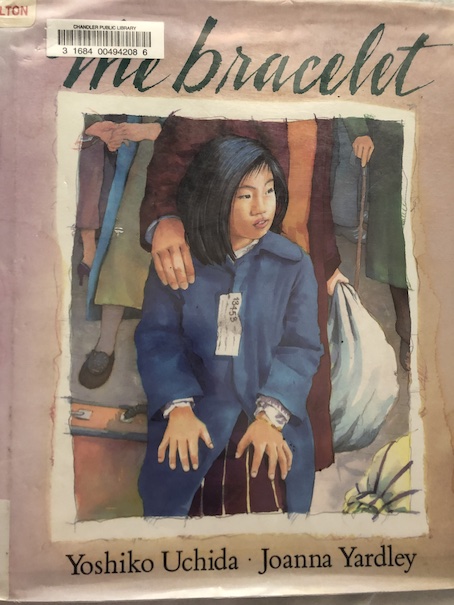
The Bracelet by Yoshiko Uchida, illustrated by Joanna Yardley, 1976, 1993.
Emi is a young girl, a second-grader, in a Japanese American family in 1942. After the Japanese attack on Pearl Harbor, there was widespread paranoia about people of Japanese descent in the United States. In response to the fear that these people could secretly be spies for Japan, many of them were ordered to go to internment camps for the duration of the war. Emi’s family is one of those families.
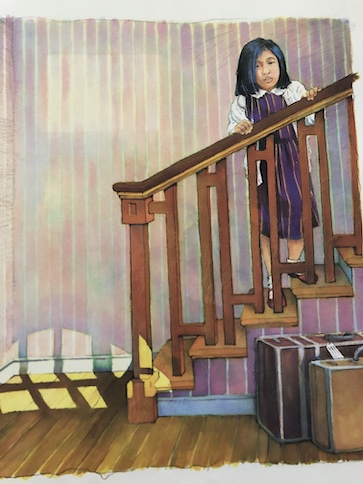
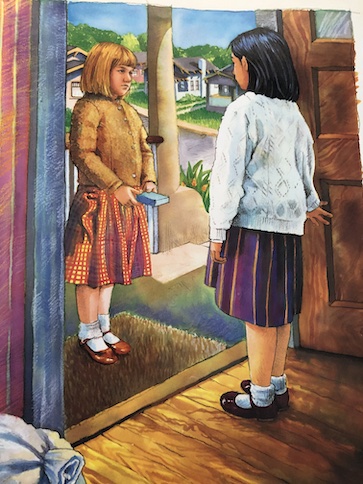
When the story begins, her family has packed and is preparing to report to one of these camps. Emi is sad to leave her home and worried about where they are going. It’s particularly hard for her to leave her best friend. Before they go, her friend stops by with a special present, a bracelet for her to remember her friend by. Emi promises that she will always wear it.
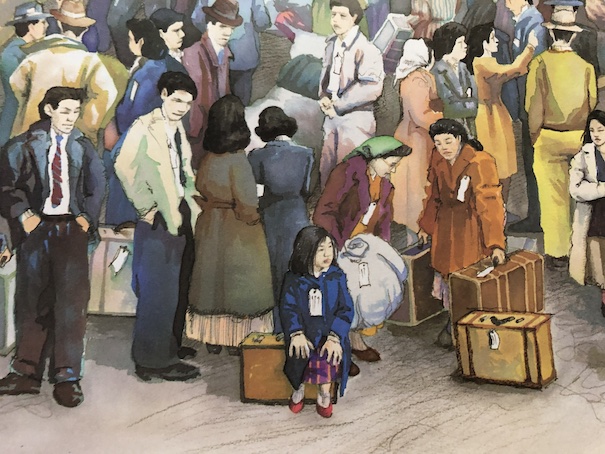
The move to the camp involves a long bus ride and crowds of people. When they get there, Emi’s family is assigned to a barrack made out of an stable because the camp is in an old, converted racetrack (this is a description of Tanforan Assembly Center from real life), and it’s not a very homey place. It’s dirty and still smells like horses. The camp is surrounded by barbed wired wire, and they have to line up with everyone else for meals. They know that this is a temporary camp and that they will later be sent somewhere else. (They will be sent to Topaz.)
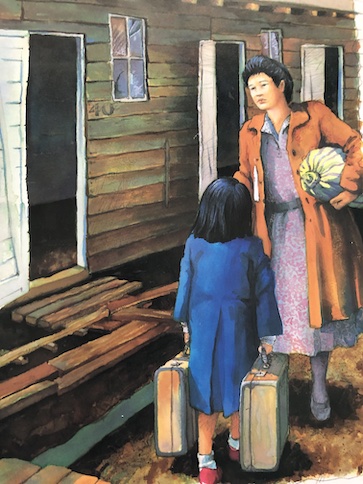
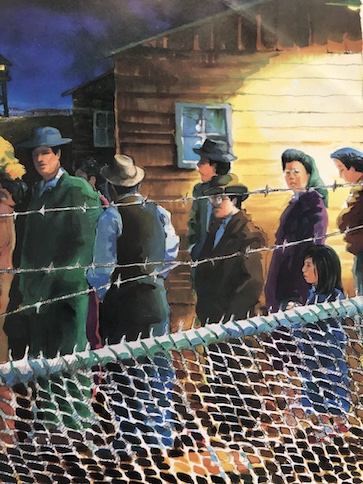
Then, Emi suddenly realizes that she no longer has her bracelet. She must have lost it somewhere in the move to the camp! They look everywhere, but they can’t find it. How is Emi going to remember her best friend without that special present?
The book is available to borrow and read for free online through Internet Archive (multiple copies).
My Reaction
The author of this book, Yoshiko Uchida, has also written other books about Japanese internment camps during World War II and the experiences of the people there and their experiences with returning to normal life after the war. When she was a young woman, she and her family were also held in the Japanese internment camps, giving her direct knowledge of the conditions there and insight into the affect that the camps had on the lives of ordinary people. The experiences of the people in her stories follow the experiences of her own family.
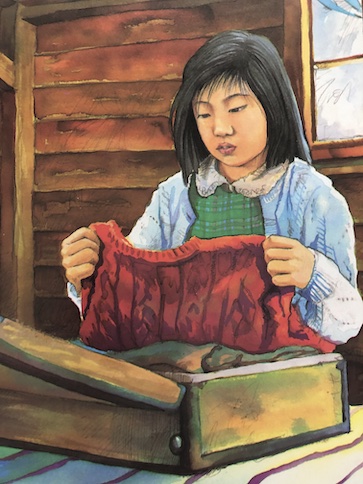
This particular book would make a good introduction to the concept of Japanese internment camps for children. It shows one of the camps through the eyes of a young girl, and it’s not a very friendly or welcoming place because it is essentially a prison. It’s an unfair prison because the people there haven’t done anything wrong, and that comes through in the story. (“They hadn’t done anything wrong. They were being treated like the enemy just because they looked like the enemy. … They loved America, but American didn’t love them back. And it didn’t want to trust them.”) They’re only there because some people are suspicious that some of them might do something wrong because of their ethnic background. Kids can understand the unfairness of the situation and Emi’s feelings at leaving her home and her friend. It’s not an easy topic to discuss, but the feeling of unfairness is a universal one, experienced by humans of all ages. Everyone has experienced something in their life, big or small, that was unfair, so the emotion isn’t difficult to understand.
Nobody is physically hurt doing the story, and nobody is called any racial slurs, making this a relatively gentle introduction to a difficult topic. There are soldiers with guns watching the people going to the camp, and they wonder if those guards are really going to shoot anyone who tries to run away, but nobody is shot. The presence of the armed guards is the most overtly scary part of the book, although there is also an atmosphere of general uncertainty because Emi and her family don’t know what’s going to happen next.
Through Emi’s thoughts, kids can understand that these are ordinary people who have been caught up in something larger that has changed and complicated their lives. The book doesn’t cover much about life at the camp because it’s a short book that mainly covers Emi’s feelings at leaving home and her arrival at the camp, but it sets the scene well for longer, more difficult books, to fill in the blanks.
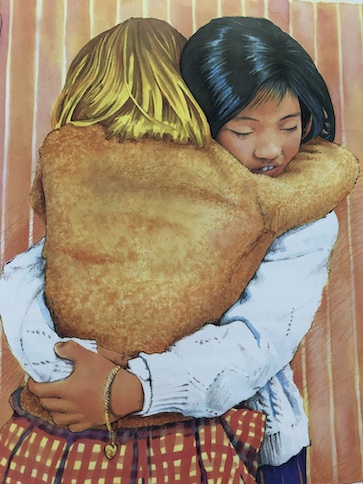
The bright side to the story is that Emi realizes that her memories of her friend don’t depend on a physical object, like the bracelet. She has memories of all the fun things she and her friend did together, and as long as they remember each other, they will still be friends. We don’t know from this book whether Emi will ever see this friend again or not, but I think that Emi appears as a secondary character in other books by the same author. I think she’s a friend of Yuki in Journey to Topaz and Journey Home.
The edition of the book that I used for my review is the one from 1993. There is a section in the back of the book with historical information about the Japanese internment, and the section in my edition has updated information that wouldn’t have been in the original version of the book. The story was first printed in 1976, but the historical section in my edition ends with the conclusions reached in 1982 by the Commission on Wartime Relocation and Internment of Civilians established by President Carter to investigate the causes of the Japanese internment. The conclusion of that commission was the Japanese internment was the product of racism, paranoia, and hysteria on the part of the public and a failure in leadership on the part of the government for trying to placate the hysterics at someone else’s expense instead of holding firm, providing reassurance and firm leadership, and emphasizing the true reality of their unreasonable fears. (Remember, that doesn’t just come from me or from this picture book. Those were the very real conclusions of an official government commission. I do agree with that assessment of the situation, though. I strong feelings against people who are obsessed with conspiracy theories and insist on spreading them because rumors do very real harm.) I think the earlier edition also had different illustrations because the copyright on these illustrations is only for 1993. I really liked the pictures in this book. They’re colorful pictures that look like watercolor paintings. They have almost a dream-like quality that fits well with the theme of memory.
As I was reading this and writing my review, I tried to remember how old I was when I first learned about Japanese internment camps during WWII and what books I might have read about it when I was a kid. I want to say that I was probably about 10 to 12 when I was first introduced to the topic, and I’m positive that I knew about it by the time I finished middle school, but I can’t remember exactly. I don’t think I read many books about it when I was young, although I remember that Farewell to Manzanar was one that was often recommended. I think my first introduction to the topic was probably either non-fiction, from history class in school and things my parents told me, but I also have a vague memory of being told about Farewell to Manzanar and asking what it was about, so that might have been what started the conversation.

