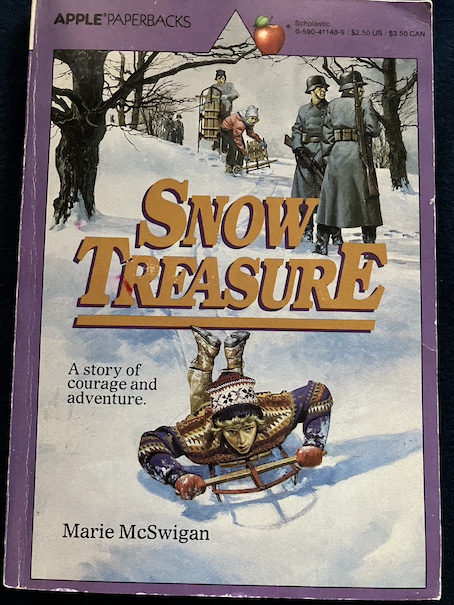
Snow Treasure by Marie McSwigan, 1942.
The story takes place in Norway, during the winter of 1940. A group of children are sledding on a hillside when they see Peter’s Uncle Victor walking with a friend of his. Uncle Victor is a fisherman, and Peter loves hearing the stories he tells whenever he’s back from a trip. The children call and wave to him, and he waves back, but he doesn’t stop or call back to them. It seems a little out of character for him because he usually gives them more enthusiastic greetings and likes spending time with him. Peter is surprised that his uncle is even there because it seems early for him to arrive.
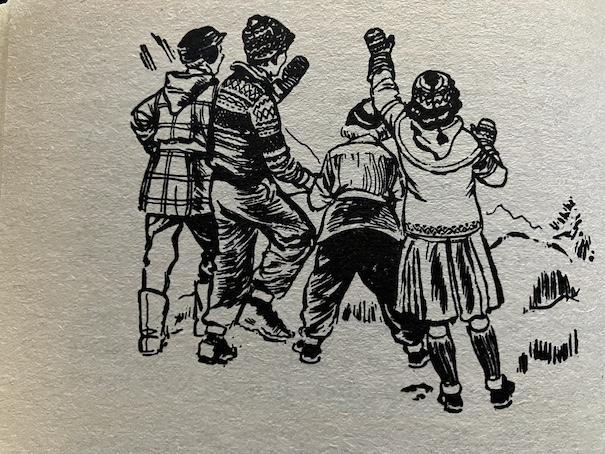
The children continue playing in the snow, starting a snowball fight. When it starts getting dark, the children realize that they have to get home to supper. At first, they think that their parents will be angry that they’re late, but the parents seem preoccupied and don’t seem to notice. When Peter mentions that he saw Uncle Victor, his father suddenly jumps up, looks alarmed, and says that he has to go out. Peter wonders if Uncle Victor is in some kind of trouble, and when he tries to ask about it, his mother doesn’t want to talk about it. He just says that Peter’s father has been working hard at the bank and that they just had a visit from a treasury official. Peter’s sister worries that the bank might be in trouble, but their mother says that the bank is fine and that it has more gold than ever. Peter asks if it has something to do with the war because even the children know about the Nazis taking Poland and how worried that the adults have been since. Peter’s mother says, yes, it’s about the war, but she doesn’t really explain more.
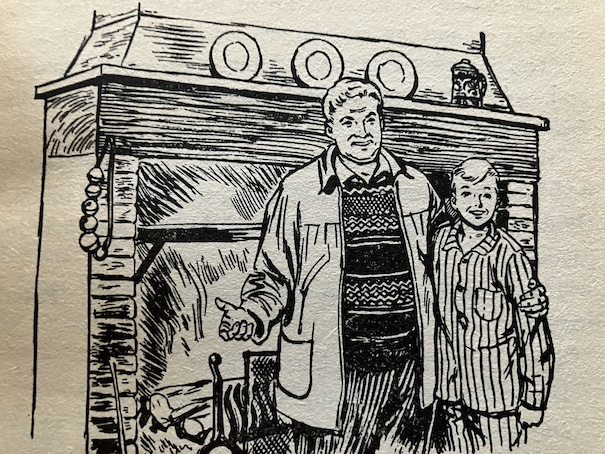
Later, Peter wakes up and hears his father and some other men talking about gold bouillon. The men talk about how they’re going to keep Norway’s gold out of the hands of the Nazis. When the men notice that Peter is watching them and listening, Peter’s father tries to send him back to bed, but Uncle Victor insists that Peter stay because Peter has just given him an idea. Peter is almost thirteen years old, and Uncle Victor realizes that he and his friends can help them. He asks Peter about how many children are in the local school and how many are over 10 years old. It’s a small school, and Peter thinks that there are about 20 children in the local school who are more than 10 years old, including the girls. Uncle Victor asks him about how he and the others could handle making a really long sled ride to the place where he docks his boat. It’s miles away, but Uncle Victor and the other men used to do it when they were children, and Peter says that he and his friends could do it, too.
The men send Peter back to bed while they talk over their plans, but they say that they’ll talk to Peter more later. As Peter lies in bed, he thinks about what they’ve told him so far. He knows that they have a large amount of money in gold bouillon, and they want to be sure that it stays out of the hands of the Nazis, but what is the point of the sleds and Uncle Victor’s boat? As he thinks about it, he realizes that they mean for the children to transport the gold to the boat on their sleds. They were talking about other modes of transportation that they’ve considered, and they’ve decided to have the children carry it for them. Peter wonders how much weight their sleds can carry because gold is very heavy.
The next day, as he and his sister walk to school, they watch some of the men building what looks like strange-looking sheds. The men say that they are building bomb shelters. When Peter and his sister ask them if they’re afraid of bombings from the Nazis or the Russians, the men say that they’re not really afraid of bombings from either one. The bomb shelters are just in case.
Other children have also noticed the bomb shelters, and everyone at school is restless and uneasy. Some of the younger children are so upset that they start crying, and some children have to be sent home. Then, Uncle Victor comes to talk to the students. Instead of telling them one of his sea stories, he’s there to help them form a special club and that they’re going to do something to help their country. He calls it the Defense Club, and he appoints Peter as the club president. Uncle Victor says that everyone is in the Defense Club and that they must all follow Peter’s orders.
The next day, Peter’s father says that he’s going to show them the route that he wants Peter to lead his friends along. He wants to be sure that Peter remembers the way to go and can do it without help. Along the way, they talk about the gold and the importance of keeping it out of enemy hands. The treasury official who recently visited the bank has decided that the best thing to do to make sure that their country’s gold can’t be captured by the enemy is to send it to a safe place. Other countries have sent their gold to the United States for safe-keeping, so Norway plans to send at least part of its gold bouillon to the United States as well.
However, there has been a recent development. Enemy ships have been sighted off the coast of Norway, laying mines. This is going to make getting the gold out of Norway by ship difficult and dangerous. Peter’s father and his friends lead Peter to a cave that Peter never knew existed before. The men say that the reason why Peter never knew there was a cave there is that they dug out this cave themselves. This is where they will hide the gold.
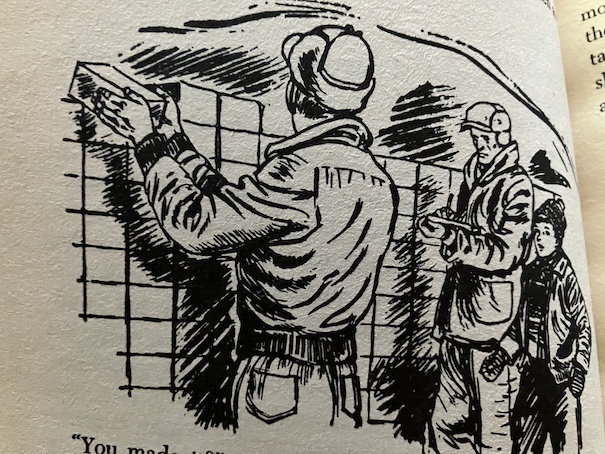
The following night, April 8, Norway is under black-out conditions in case of bombings. Not a single light is allowed after dark, and people are afraid. The bomb shelters are ready, and they have blocks of ice ready in place of sandbags. Soon, Peter’s father will leave to join the army, and he says that Peter will be the man of the house while he’s gone. Peter asks him what to do about the gold, and his father says that Uncle Victor will tell him when and if they need to move it. In the meantime, Peter is to pretend that he knows nothing about it and not tell anyone anything.
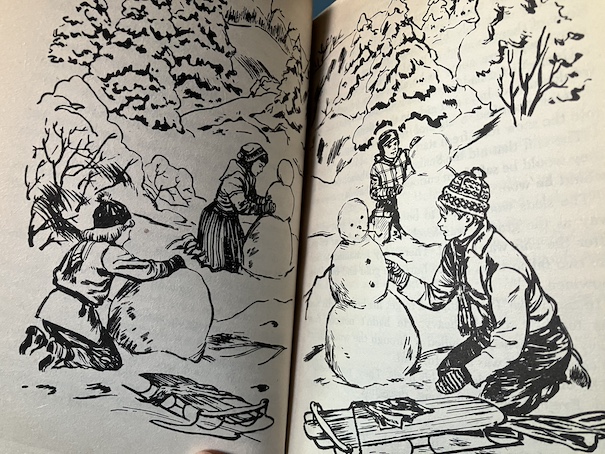
When Peter speaks to Uncle Victor, Uncle Victor tells him that he wants Peter to make sure that he and his friends go sledding regularly in the area. If the Germans are watching, and they see the children often sledding, they’ll start ignoring them. It would only look weird if the children started going places where the Germans haven’t seen them before. He also explains that the children will be divided into teams of sledders with Peter and some of the other, oldest children leading each team. Peter asks Uncle Victor why it’s important to move the gold when the sea is mined. If Uncle Victor doesn’t know where the mines are and can’t navigate around them, he won’t be able to get the gold out anyway. Uncle Victor says that he will be learning the locations of the mines, and he wants the gold ready to go when the time comes, so he can get it out quickly. He adds that Peter is not to question orders from this point forward. The adults teach the children how to tie and untie the gold from their sleds.
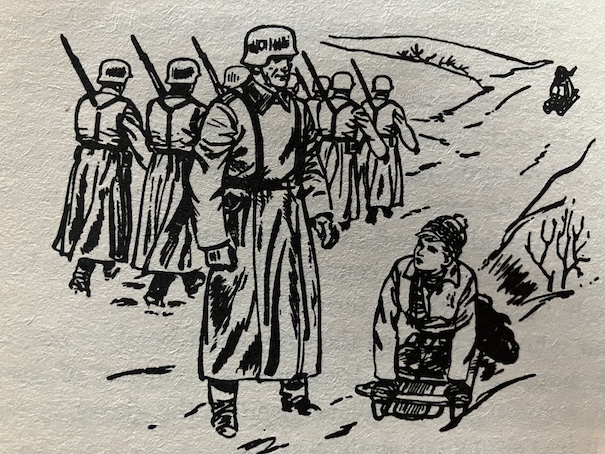
As Norway becomes occupied by the Germans, the children have a scare when they run into a Nazi patrol, but the Nazis move out of the children’s way to let them sled. One of them comments to the children that he wouldn’t interrupt their sledding because he liked to sled when he was a boy, too. The children are thrilled with their brush with danger and how the Nazis just let them through. In spite of the friendliness of the Nazi soldiers, however, the children refuse to talk to them. The adults ordered them to not speak to the Nazis so they can’t let anything slip to them. The Nazis try to offer the children candy to make friends with them, but the children won’t take it or even say a single word to them.
Transporting the gold is a long process because the children can’t carry much at a time. The adults are nervous because it won’t be much longer before the snow melts, and the children won’t be able to sled. Also, Uncle Victor’s boat hasn’t been where he usually docks it, so the children have been burying the gold in the snow at the docking point until he returns. Then, a late blizzard comes.
The blizzard is unusually fierce, and it lasts for days. The Norwegians don’t find it too difficult because they are prepared for storms like this, and they spend the blizzard at home. The Nazis have suffered during the blizzard because they weren’t prepared for it, and they’re in a bad mood when it’s over.
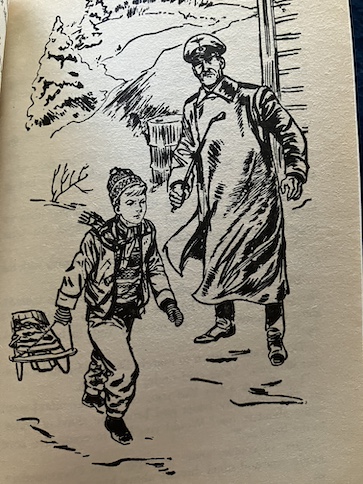
One day, one a commandant tries to offer Peter a job living in their barracks and shining his shoes. (These aren’t even tempting conditions.) When Peter still refuses to even talk to him, the commandant gets angry, and he says it’s a sign of how stupid the Norwegians are. He says that the children are stupid because they’ve been out of school too long, and it’s time for them all to go back to school. At first, the children aren’t too concerned about this threat because they know that the schoolmaster of their small school has left to join the army, and there’s no one in town to teach the school. However, the Germans say that the school will reopen even if one of the German soldiers has to teach it. This is a worry because, while the snow dumped by the blizzard has bought them some time to finish their sled deliveries of gold, if the children are back in school all day, they won’t have enough time after school to finish the job. The adults have to come up with a plan that will keep the children out of school long enough to finish their mission.
The book is available to borrow and read for free online through Internet Archive (multiple copies). The story was later made into a movie in 1968. The movie is available to watch on Amazon Prime Video, or the movie or clips of it sometimes appear on YouTube.
My Reaction and Spoilers
Based on Real Events?
I liked this story because of the combination of historical events and adventure. What interested me most about the book is that the it was written and published during WWII itself, and the author claimed that it was based on real events, although she admitted that some of the details were invented for the story.
There are many stories about people resorting to unusual and imaginative methods to smuggle items and people past enemy soldiers during the war, so it does beg the question about whether real children helped to smuggle gold past the Germans on their sleds. There are no definitive sources to verify that the story about the sleds is true, and some people doubt it, although the smuggling of gold out of Norway is true. It is true that, in 1940, about $9,000,000 worth of gold bullion from Norway arrived by in Baltimore, Maryland, carried by a freighter called Bomma. At the time, the ship’s captain told a story about children transporting gold secretly on their sleds, which is probably where the author got the idea for the story.
The author herself said that, in real life, there were more children and adults involved than she included in the story, which is also true, although whether or not they used sleds as part of their operation is the part that is still difficult to verify. There was an article in an Australian newspaper from 1941 which described a large-scale military and civilian effort in Norway to smuggle gold bullion out of the country by various means, including trucks and small, private boats. Some of the details of this account shed a little light on the larger situation. According to the story in the Australian newspaper, some civilians acted as village guides, helping to guide gold-carrying trucks through forests to reach the sea, where it would be loaded onto ships. There, some of the gold was loaded aboard a British destroyer and cruiser, but the cruiser had to leave early due to German bombing, and some of the gold was left behind. Civilians, including patriotic men, women, and children helped in the efforts to transport the remaining gold to a freighter, using small, private boats, traveling by night along the edges of the fjords.
It does seem that at least some children were involved in the effort, but their exact roles are uncertain. From the Australian description, it seems that some of them may have been aboard the small boats transporting gold. If sleds were also used to transport some of the gold, the article doesn’t mention it, but the absence of a mention doesn’t necessarily mean that it didn’t happen at all. Even if most of the gold was transported by other means, it is still possible that sleds were used to carry some of it, part of the way. Because the smuggling of the gold was meant to be secret, I suppose the people involved couldn’t really admit to their involvement at the time or offer too many details. Since the end of the war, it seems like nobody has claimed to be one of the children who transported gold on their sleds, so that part of the story remains unverified, and it could be exaggerated or legend.
Spoilers
The plan that the adults come up with is to fake an epidemic in town that will keep the schools closed. The town doctor is in on the plot, and he paints the younger children in town with spots to make it look like they have something like the measles. He insists that the school remain closed until the illness that the people in town call “the plague” (because they can’t pronounce what the doctor claims it is) has passed. In the meantime, he wants the older children in town to stay away from the younger children and spend as much time outside as possible. The younger children are to stay inside under quarantine, and the doctor cautions the German soldiers to stay away from the children to avoid catching the disease.
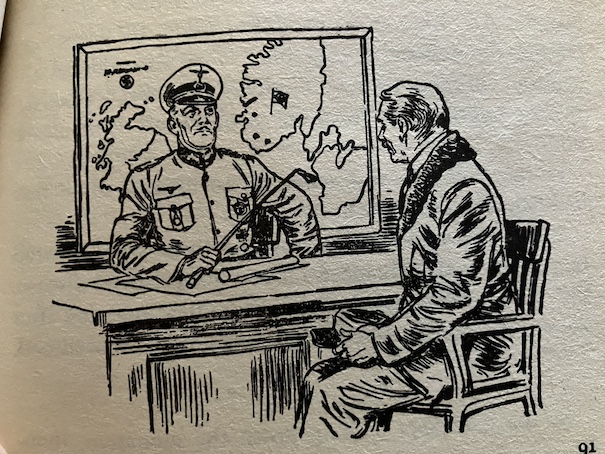
Of course, they can’t keep up this deception forever, and Peter himself is later in danger when he offends the German commander and is later take prisoner. However, there is a twist to the story because one of the German soldiers is secretly on their side and resents being pressed into the service of the Nazis. This unexpected ally helps Peter to make his escape and fulfill his family’s mission.
 Jestress's Forgotten Books and Stories