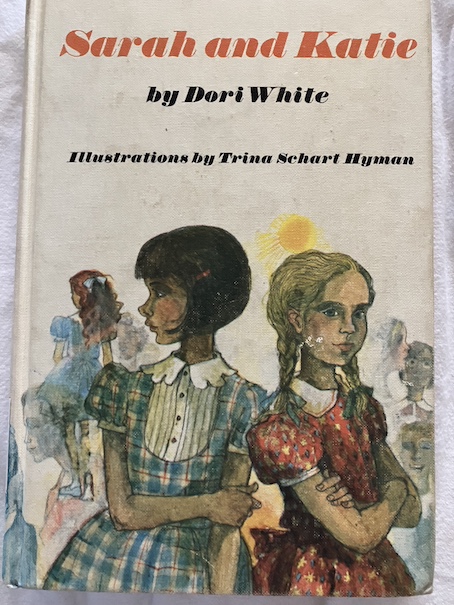
Sarah and Katie by Dori White, illustrations by Trina Schart Hyman, 1972.
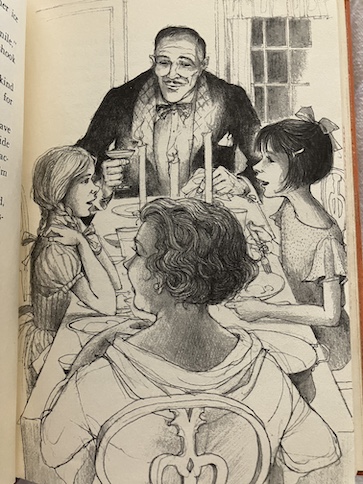
During the Great Depression, Sarah and her best friend, Katie, are in the sixth grade at school. They have been writing a play together for the Thanksgiving play contest that their drama teacher, Miss Lane is holding to decide what their class will perform for their Thanksgiving celebration.
Sarah is full of admiration for Miss Lane, who is young and beautiful and newly engaged, judging from her impressive diamond ring. Katie isn’t quite so impressed by Miss Lane because she doesn’t think she’s such a great teacher or that she likes children much. She’s noticed that Miss Lane often comes to school late, unlike the other teachers. Once, a classmate of their fell down and hurt her knee, and Miss Lane just walked right past her, like she didn’t even see her, even though it seemed like she really did. Katie is also concerned about the concept of the play because there are only so many parts in a play, and people are going to be left out. Sarah can’t understand why Katie criticizes Miss Lane so much when Miss Lane is so pretty and sweet and seems so different from their homeroom teacher, Miss Mulkey. Miss Mulkey is strict, but Katie likes Miss Mulkey because she’s fair-minded and a good teacher.
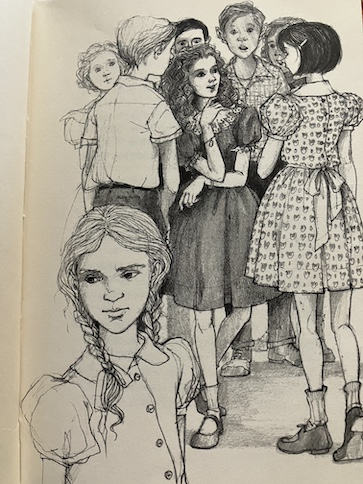
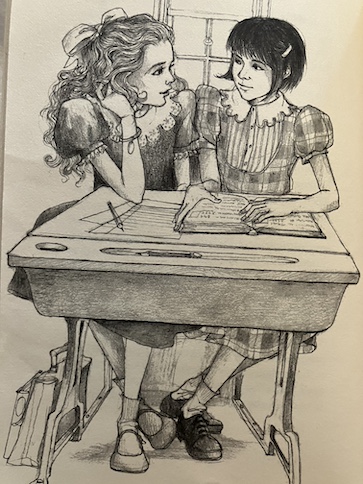
A new girl has joined their homeroom class, and Sarah is fascinated with her. The new girl, Melanie, has lovely red, curly hair and wears wonderful clothes when most of the girls in class are lucky to have 2 or 3 nice school dresses because of the Depression. Melanie used to live in Hollywood, California, and the other kids in class are fascinated, asking her about movie stars she’s seen. Katie isn’t thrilled by Melanie because she thinks that the clothes that she wears are too fancy for school and that she’s just showing off with her talk about movie stars. Sarah thinks that Katie isn’t being fair to Melanie, and Katie says that Sarah only sticks up for Melanie because Melanie is pretty. Sarah denies it, but it’s true that Sarah is fascinated by Melanie’s glamorous clothes and pretty face with pale, delicate features. The more Sarah thinks about it, the more she thinks Melanie looks just the way that she had pictured the wealthy girl in the play that she and Katie wrote. She especially starts thinking about it about when other girls in their class tell Melanie about the upcoming Thanksgiving program and the play contest. Melanie says that she’s had acting classes, and she would be happy to be in the winning play … as long as she can choose any part she wants.
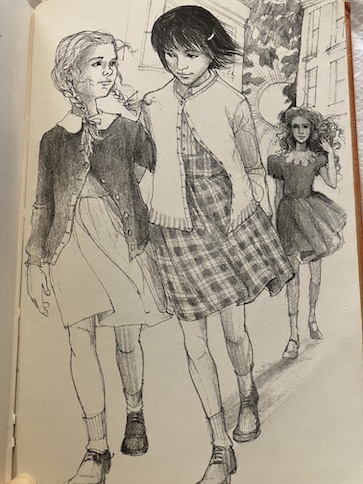
Sarah and Katie are thrilled when their play is chosen as the winning play. Sarah loves writing, and having a play that she helped write performed means a lot to her. However, problems arise between her and Katie when Melanie repeats her offer to Sarah, that she will be in their play if she gets to choose her role. It’s pretty obvious to both Sarah and Katie which part Melanie wants. Originally, the understanding was that Katie would play the lead character, Collette, a wealthy and generous but frail girl. However, Sarah has already started thinking how great Melanie would look as Collette and is charmed by Melanie’s glamorous Hollywood background, her rich-looking clothes, and acting experience. Katie can read the situation well and knows what Sarah is thinking.
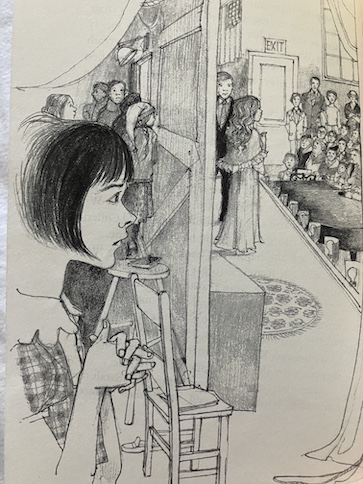
Katie knows that the success of the play is important to Sarah because of her love of writing, and they’ve agreed that Sarah will be the director of the play rather than have an acting role. Sarah’s father says that directors tend to be underappreciated because actors get the credit when a play goes well and directors tend to get the blame when things go wrong. Sarah says that she doesn’t care because she only wants the play to be successful. Understanding how her friend feels, Katie tells Sarah that, if she thinks Melanie would be better for the role of Collette because she’s a more experienced actress, she would be willing to let Melanie have that part. Even though Katie says that it’s okay for Melanie to have the part and that she will understand if Sarah wants Melanie for the role, Sarah feels torn about the choice because she is concerned about Katie’s feelings. Sarah’s father tells her that, as the director, she has to make the choice, even though it’s difficult. When Melanie insists that she wants the part of Collette and Sarah agrees she can have the lead in the play, it does affects her friendship with Katie.
Melanie invites everyone working on the play to come to her apartment for a rehearsal, but instead of rehearsing, Melanie takes up all the time goofing off and showing off for the other kids, until they all have to go home for dinner. Sarah and Katie are among the last to leave at five o’clock, and when Melanie realizes what time it is, she quickly puts on her bathrobe. It’s a strange thing to do, but Katie thinks she knows the reason. Melanie’s mother wasn’t home the entire time the other kids were at the apartment, and Katie thinks that Melanie’s mother probably works and has no idea that Melanie invited the other kids over or that Melanie has been wearing her best clothes to school to show off, so Melanie threw on the bathrobe before her mother could get home and see her wearing a dress that isn’t appropriate to wear to school. Although Sarah has noticed these oddities about Melanie’s behavior and is irritated at Melanie wasting their rehearsal time, she’s also annoyed at Katie pointing out all these negative things about Melanie. Sarah and Katie get into an argument, and Sarah accuses Katie of simply being jealous of Melanie, causing Katie to storm off angrily. Although Katie continues to work on the play, she stops speaking to Sarah, only communicating through other people.
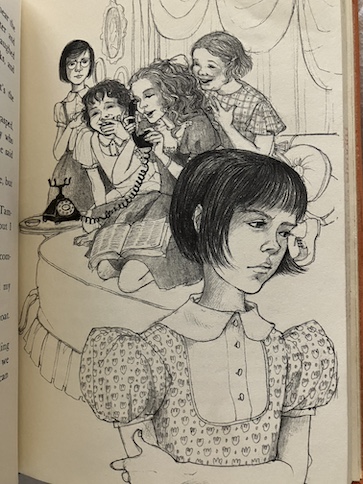
Sarah feels terrible about their fight, and she soon realizes that she has been mistaken about the true characters of various people, especially Melanie. Although Melanie is undeniably charismatic, Sarah finds out that this new girl is deeply troubled, and she acts out in various ways. Sarah is annoyed when she hijacks another informal rehearsal of the play at Melanie’s house to make prank phone calls and show off for the other kids. Other members of the cast also stop coming to rehearsals at Melanie’s apartment because her mother isn’t home, and there isn’t much real rehearsing going on. Sarah doesn’t like the things that Melanie does or the things that she influences the other girls in her class to do, and she feels guilty about the prank calls and the fact that she can’t seem to take charge of the rehearsals as director. Katie was right that Melanie is a problem, and Sarah just didn’t see it because she was too impressed with how Melanie looked and how charismatic she was.
Sarah starts holding rehearsals at school to avoid the problems of Melanie’s behavior at her apartment, and she also starts to realize that Miss Lane isn’t helping them prepare for the play as she promised at all. When Sarah tries to ask Miss Lane about helping them with the costumes and scenery, she just snaps at Sarah that it’s her responsibility and that she can’t do everything for her. Sarah doesn’t know what to do because she doesn’t know anything about scenery, and she begins realizing that Miss Lane, although pretty, isn’t really the nice teacher she thought she was. Fortunately, Sarah begins to pull things together with some help from the other students and from the nice janitor, Mr. Scott, who knows about the scenery stored at the school.
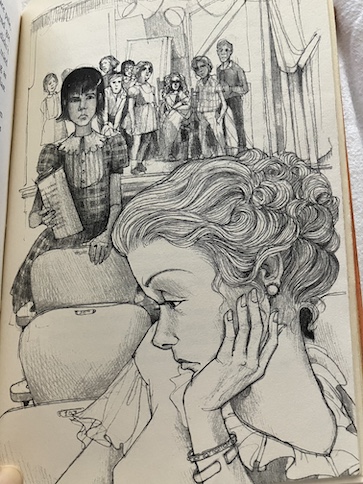
Then, Miss Lane’s diamond engagement ring disappears, and someone makes an anonymous phone call, accusing the class bully of taking it. Although the class bully, Danny Wade, is an intimidating, disreputable kid who is physically rough and has given the other kids a hard time, and many people think it would be in character for him to steal something valuable, he denies doing it. At first, Sarah’s as ready to believe Danny is guilty as everyone else, but circumstances cause her to reconsider. Having started to consider the true characters of people, it doesn’t take Sarah too long to realize who made the anonymous phone call accusing him of theft and that the accusation isn’t any more true than many of the other things Melanie has said. When Sarah confronts Melanie with her suspicions, she lashes out at Sarah.
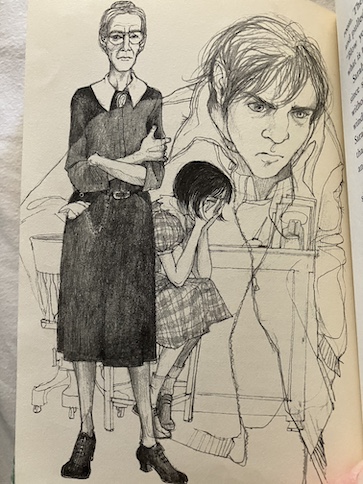
With her moodiness, instability, and anger at Sarah, Melanie’s participation in the play becomes doubtful. If she pulls out as the star of the play, will they be able to manage without her? What really happened to the teacher’s ring, and what will happen to Danny Wade if they can’t prove that he didn’t steal it? Above all, will Katie ever be Sarah’s best friend again after everything that’s happened? Sarah is going to need some help to straighten everything out, and she comes to realize that the people she can rely on the most are the ones who are the most understanding, caring, and steady, not the ones who are the most beautiful and seem the most impressive and charismatic.
The book is available to borrow and read for free online through Internet Archive (multiple copies).
My Reaction and Some Spoilers
I remember reading this book when I was a kid, although I forgot many of the details. Either I had forgotten that it was supposed to take place during the Great Depression or I was young enough at the time that I just took the vintage aspects of the story for granted because I knew I was reading an older book, not fully appreciating that this is supposed to be a period book, even for the time period when it was written. The Great Depression is kind of in the background of the story, not a main plot line, although it does make a difference because the other kids in the story see Melanie as being more fortunate than most of them are. She has nicer clothes than they have, and they admire her for the glamorous (or seemingly glamorous) life that she supposedly comes from in California, among the actresses and actors of the Golden Age of Hollywood. Melanie tells them that she doesn’t know any famous people well, but she has seen Greta Garbo in her limousine and has petted the famous movie dog Rin Tin Tin, naming celebrities from the early 1930s. As an adult, I appreciated some of the historical details that I missed when I was younger.
I also appreciated that the adults in the story aren’t oblivious to the children’s problems. They don’t always know the right answers or approach situations in the right way, and they do let the kids work some things out for themselves, but they are concerned about what’s going on with the children and want to hear what the kids have to say. Both of Sarah’s parents know what’s going on with her play project and her friendship with Katie. Sarah’s father points out the difficulties involved with the job of being the director of a play but makes it clear to Sarah that the decisions are hers to make because that comes with the job, letting her make the difficult choices, “right or wrong”, as he points out, because this is a valuable learning experience.
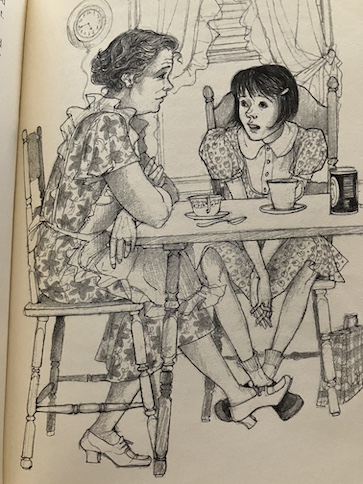
When Sarah worries about the things she’s been learning about Melanie’s true character and her problems with Katie, her mother listens patiently and tells her that she’s known people like Melanie before. She understands how charismatic people like Melanie can be fun and fascinating, but she also points out that Sarah is learning that there are not-fun sides to Melanie and the trouble she causes. She also adds the adult perspective that Melanie isn’t as fortunate as she seems and is actually a very unhappy girl, which is why she’s acting out in the ways she is, something that Sarah’s father agrees with. Sarah’s mother has a talk with Melanie’s mother and learns the truth behind Melanie’s situation. The truth is that Melanie’s parents have a troubled marriage and are on the verge of splitting up. Melanie is upset about having to leave her home and her friends to come to a new place where she doesn’t really know anybody and her mother has to work all the time to support the two of them. Sarah comes home from school to a house with happily married parents who know and care about what’s going on in her life and a mother who listens to her and helps her talk through her feelings and problems, but Melanie is frequently alone as her parents try to solve their own problems.
There is kind of a moral to the story because, while Melanie looks more the way Sarah pictured the character in the play, Sarah remembers that Katie was always the true model for the character because the character’s generosity, which is the heart of the play, is really Katie’s generosity and caring. Appearances aren’t everything. At the end of the story, Katie points out that Sarah has a tendency to judge people by their appearances rather than their real behavior. She overlooks or makes excuses for the things people do if those people are good-looking. She makes it a habit to assume the best of people who look nice to her, even in spite of evidence that they aren’t really nice people, and the worst of people who aren’t good-looking.
Although Sarah is offended by that assessment at first, she has to admit that there is some truth to it and that she’s been wrong about various people because she was judging them mostly by appearances. Sarah thought Miss Lane was a great teacher because she was young and pretty, and she admired her looks. It takes some time and experience for Sarah to notice what Katie saw right away, that Miss Lane is not really serious about her job as a teacher and not very concerned about the children or their project, which is her direct responsibility as their teacher. When Sarah asks Miss Lane if she can still direct the play as a student, Miss Lane tells her yes, and when Sarah asks if she will be helping her with the place, Miss Lane replies that it’s unfortunately part of her job. Sarah is stunned by the strange phrasing of the reply, which shows Sarah for the first time that Miss Lane considers the work that she is being paid to do as a teacher and the children themselves as an inconvenience. As the project continues, Sarah begins to see more of what Katie means about Miss Lane’s lack of devotion to teaching. Miss Lane gets upset when she’s expected to help the students, acting like they’re asking too much of her to do her job, and they stop trying to rely on her at all, instead turning to the kind school janitor to help with the scenery for the play. Sarah comes to realize that all Miss Lane ever thought about or cared about was her boyfriend and her engagement. She only works while she’s biding her time to get married, and she can’t wait to be done with this job. It seems particularly ungrateful of Miss Lane because this story does take place during the Great Depression, when many people are out of work and would be grateful simply to have a job. The book doesn’t go into this point, but it jumped out at me as an adult, and her ingratitude is a stark contrast to the spirit of Thanksgiving.
On the other hand, Miss Mulkey, who Sarah had written off as being old, grumpy, and strict is actually the devoted and caring teacher Katie had always believed her to be. When Sarah is upset about the way things are going, it’s Miss Mulkey who listens to her and offers advice and reassurance at school. Although she isn’t the drama teacher, Miss Mulkey is far more interested in actually watching the play the students have been creating than Miss Lane is. Miss Mulkey can be strict with her students sometimes, but Sarah comes to realize that she only does it when it’s in their best interests, trying to keep them focused and on task. She is actually understanding, sympathetic, and patient when her students are struggling or things happen that are beyond their control. Katie is right that Miss Mulkey is fair-minded, and she is supportive when that’s what her students need. Miss Lane truly doesn’t care at all and is mentally absent much of the time because she’s thinking of her own priorities.
However, Sarah does insist that her sympathy for Melanie goes beyond appearances. As a writer, Sarah finds Melanie to be a compelling character. Melanie isn’t a great friend, like Katie is, but Sarah can see that she’s an interesting person to know. She also feels a little sorry for Melanie because, as her mother pointed out, Melanie does have it rough in some ways. Katie says that having things rough isn’t an excuse for some of the bad things that Melanie did because everyone has it rough sometimes. Sarah is less convinced of that, even at the end. Katie is correct her assessment of people’s actions and characters, and it’s true that sometimes Sarah is a little too swayed by people’s outward appearances, but one other thing that Sarah has learned from her experiences is empathy for other people. Melanie is a trouble-maker, but Sarah sees that her parents are right that it’s only because she’s troubled herself. Even though Danny Wade is a pain, she comes to see other sides of him, too. Danny and his mother are poor, but his mother loves him and believes in him, and Danny acts out sometimes because he wants to be included with the other kids but doesn’t really know how to make friends or let the others know that he wants to be part of their projects. Even though Sarah is no longer enamored or admiring of Miss Lane by the end of the story, she also mentally concedes that Miss Lane is preoccupied because she has found the love of her live, and all she wants to do is be with him. It doesn’t mean that any of these people should act the way they do, but Sarah parents say that it can help to understand why they do the things they do. That understanding helps Sarah to be less angry at them than she might otherwise be.
Fortunately, the story does end happily, with Danny’s name cleared and Melanie’s parents reconciling. The ring wasn’t really stolen, and Miss Lane is in trouble with the principal because it turns out that she only misplaced the ring and too quickly blamed the students for taking it. However, Miss Lane is leaving teaching to get married, and she never really cared about her job anyway, so she’s not at all sad about the loss of her job or concerned or apologetic about the chaos and angst that she caused in the lives of the students before her departure. She just happily takes her ring and leaves.
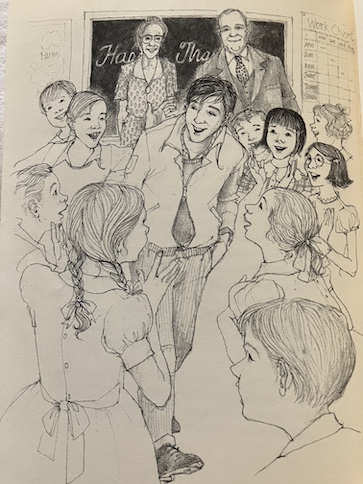
I also love the realistic illustrations that accompany the story! The pencil drawings are realistic and detailed and really capture the personalities of the characters in the story. I think that books with excellent illustrations help make the story come to life!

